Showing posts with label verse novel. Show all posts

Thursday, April 25, 2019

Classroom Connections with David Elliott


TODAY'S READ

Voices: The Final Hours of Joan of Arc

David Elliott, Author

HMH Books for Young Readers (March 26, 2019)
ISBN: 978-1328987594

For ages 14 to adult

Purchase at Amazon.com
Purchase at Barnes & Noble
Purchase via Indiebound.org


SYNOPSIS

Told through medieval poetic forms and in the voices of the people and objects in Joan of Arc’s life, (including her family and even the trees, clothes, cows, and candles of her childhood), Voices offers an unforgettable perspective on an extraordinary young woman. Along the way it explores timely issues such as gender, misogyny, and the peril of speaking truth to power. Before Joan of Arc became a saint, she was a girl inspired. It is that girl we come to know in Voices.


A PEEK INSIDE

© 2019 by David Elliott, from Voices: The Final Hours of Joan of Arc (HMH Books for Young Readers)


ABOUT THE AUTHOR

Read David Elliott’s spotlight interview
on Today's Little Ditty HERE.

David Elliott is the author of over twenty picture books and novels for young people, including The New York Times bestselling And Here’s to You!. Other books include The Transmogrification of Roscoe Wizzle; Finn Throws a Fit; Baabwaa and Wooliam; the This ORQ series; and the poetry series On the Farm, In the Wild,  In the Sea, On the Wing and In the Past. His YA novel in verse Bull (2017) garnered six starred reviews and has been compared to Hamilton. Voices: The Final Hours of Joan of Arc was released in March of this year. Before becoming a writer, David worked as an olive picker in Greece, a popsicle stick maker in Israel, and a singer in Mexico. He is a founding member of Lesley University’s Low Residency Program in Creative Writing, where he still teaches. Currently, David lives in New Hampshire with his wife and Dandie Dinmont terrier, Queequeg.


CLASSROOM CONNECTIONS

Why is bringing poetry into the classroom important?

Well, this is like asking why it’s important to bring math into the classroom, right? And I love that the question refers to bringing poetry into the classroom, rather than teaching it. Bringing poetry to young people is an act of love. If we’re not very careful, teaching it is like refusing to give a starving kid dinner until she can recite every ingredient that went into its preparation. There are so, so many reasons to get poetry into the ears and mouths and hearts of our younger citizens. Here is just one. Right now we’re all about STEM. It’s all STEM all the time. Hooray! We get it. STEM! STEM! STEM!

Yes, of course, we need great engineers, great doctors, great astronomers and mathematicians and coders. Nobody is arguing that we don’t. But if we’re going to get anywhere in this weary world we need engineers who can feel, doctors who can empathize with their patients, astronomers who can communicate the wonders of the universe to the rest of us, and mathematicians and coders who are firmly grounded in notions of what it means to be human. I can’t think of any better way to give our young women and men these skills than to sustain them with poetry. Carl Jung once defined a symbol as the best representation of that which cannot be represented. I think that’s an excellent definition of a poem. Of course, we can’t duplicate the experience of grief, or love, or jealousy, or rage, or astonishment, or confusion or any of it through metaphors, and syntax, and line breaks. But we can get close. And when we do, we get closer to all the human beings with whom we share the planet.

How might your book be incorporated into an educational curriculum?

I can think of many curricula where Voices: The Final Hours of Joan of Arc might be an appropriate text. Medieval and European History, Women’s and Gender Studies, Creative Writing Classes. Mary Ann Cappiello, professor of language and literacy at Lesley University, did an excellent job of putting together a curriculum for a Women’s History and Gender Studies course. You can find it in School Library Journal’s “The Classroom Bookshelf.”  Here’s the link: http://www.theclassroombookshelf.com/2019/03/exploring-womens-history-and-gender-perspectives-through-voices-the-final-hours-of-joan-of-arc/

I’d love to see someone do a unit asking students to write their own biographies using the structure of Voices. First, allow the kids to get two or three of the forms used in the book under their belt. Then ask them to tell their lives through poems from the perspective of people who know them, as well as inanimate objects that mean something to them—bikes, helmets, barrettes, keyboards, violins, whatever. I might also ask them to pick one voice—in Voices, it’s Fire—that repeats throughout their biography.

Can you suggest a specific classroom exercise related to your book?

WRITING A TRIOLET (TREE-o-lay)

French. Dates from thirteenth century.

WHAT YOU NEED TO KNOW
  • Eight lines
  • The first and second lines form an unrhymed couplet.
  • The end words of lines one and two set the rhyme scheme.
  • Lines 1,3,5,7 rhyme. As do lines 2,4,6,8.
  • Line one is repeated at lines four and seven.
  • Line two repeated at line eight. In other words, the first two lines of the poem are also its last two lines.
Lines can be any length, but rhyming lines are of the same length.

LET'S TAKE A LOOK
How Great My Grief


How great my grief, my joys how few,
Since first it was my fate to know thee!
Have the slow years not brought to view
How great my grief, my joys how few,
Nor memory shaped old times anew,
Nor loving-kindness helped to show thee
How great my grief, my joys how few,
Since first it was my fate to know thee?

     – Thomas Hardy (1840-1928)
YOUR TURN

Take a look at “The Arrow” on page 124 in Voices: The Final Hours of Joan of Arc. Though it has been shaped to form a concrete poem, it is, in fact, a triolet. Following the guidelines listed in the bullet points above, write a triolet in the voice of an object from your own life.  What does it have to say about you?

What is a simple, practical tip for teachers when it comes to incorporating poetry in the classroom?

When I was teaching I often began each session—no matter the content of the class—with a poem. We didn’t discuss it. I didn’t “teach” its meaning or say anything about its structure or the author. I simply read it, was silent for a moment, and then got on with the day’s lesson. Without fail if I forgot, the students—everybody from the shy girl sitting in the front row to the burly quarterback sitting at the back—complained, and bitterly. They didn’t know they needed it, but once they discovered they did, they craved it. Imagine what our country would be like if every day, every teacher from kindergarten through upper level graduate courses in cellular biology read one poem. Every class. Every day. We would be living in a different, a better country.

Can you recount a specific instance of when poetry impacted a student or group of students in a positive way?

In all my school visits I try to write a communal poem with whatever group I’m talking to. Here’s a recent one. Almost all the language of the poem came from the kids, a group of kindergarteners and first grades. They were thrilled.

Owl

I was flying, hunting, searching for prey.
I work by night, I sleep by day.
I turn my neck: I see the mole,
I take it back to my treetop hole.
Hoo! Hoo! Hoo! Hoo!

Years ago, I was teaching a college level intro to creative writing class. When we came to the unit on poetry we read Elizabeth Bishop’s “One Art.” I will never forget the expression on one of the student’s faces when we finished. She looked as if a light were shining on her, or, maybe, as if she had suddenly discovered that she was the light. That is one of my happiest memories, that little moment. And all we did was read the poem. We just read it.


CONNECT WITH DAVID ELLIOTT

Website: davidelliottbooks.com
Instagram: @davidelliott1234
Twitter: @davidelliott10

Look for BULL (click here to read the review on Today's Little Ditty), released last month in paperback.


Many thanks to David for participating in our Classroom Connections series for National Poetry Month, and for offering a copy of Voices: The Final Hours of Joan of Arc to one randomly selected TLD reader!

To enter, leave a comment below or send an email with the subject "Voices Giveaway" to TodaysLittleDitty (at) gmail (dot) com by Tuesday, April 30, 2019. Winners will be announced on Thursday, May 2nd, so be sure to check back to see if you've won!


 * * * * * * * * * * * * * * * * * * * *

Check out the other Classroom Connections posts and giveaways on offer this month by clicking the names below!


Digital art © 2018 by Miranda Barnes,
based on a line from "Ghazal" by Tracy K. Smith.


TO FOLLOW:

The best way to keep up with the Classroom Connections series is by subscribing to Today's Little Ditty via email, which you can do in the sidebar. I will also be announcing the posts on social media. Like me on Facebook and/or follow me on Twitter (also in the sidebar) to stay informed that way. Catch up with Classroom Connections posts you may have missed by clicking on the "It's time to INSPIRE" icon in the sidebar, or by visiting my "Poetry in the Classroom" board on Pinterest.

Friday, April 19, 2019

Classroom Connections with Aida Salazar


TODAY'S READ

The Moon Within

Aida Salazar, Author

Arthur A. Levine Books (February 26, 2019)
ISBN: 978-1338283372

For ages 8 and up

Purchase at Amazon.com
Purchase at Barnes & Noble
Purchase via Indiebound.org


SYNOPSIS

Celi Rivera's life swirls with questions. About her changing body. Her first attraction to a boy. And her best friend's exploration of what it means to be genderfluid. But most of all, her mother's insistence she have a moon ceremony when her first period arrives. It's an ancestral Mexica ritual that Mima and her community have reclaimed, but Celi promises she will NOT be participating. Can she find the power within herself to take a stand for who she wants to be?


A PEEK INSIDE

Click on image to enlarge.

Text copyright © 2019 by Aida Salazar, from The Moon Within (Arthur A. Levine Books).


ABOUT THE AUTHOR

Aida Salazar is a writer, arts advocate and home-schooling mother whose writings for adults and children explore issues of identity and social justice. She is the author of the forthcoming middle grade verse novels, The Moon Within (Feb. 26, 2019), The Land of the Cranes (Spring, 2020), the forthcoming bio picture book Jovita Wore Pants: The Story of a Revolutionary Fighter (Spring, 2021) - Arthur A. Levine Books / Scholastic. Her story, By the Light of the Moon, was adapted into a ballet production by the Sonoma Conservatory of Dance and is the first Xicana-themed ballet in history. She lives with her family of artists in a teal house in Oakland, CA.


CLASSROOM CONNECTIONS

Why is bringing poetry into the classroom important?

Puerto Rican poet, Piri Thomas, said, “Every child is born a poet.” In our rush to educate for tests, we forget this truth, we forget to fortify our students with the tools to nurture this ability. We scrub away the introspection and invention that children inherently have as they grow and see the world from learning eyes. Poetry offers students a way to slow down, to look inside language, contemplate its meaning, its rhythm, its sound, or the way words are arranged on the page. Poetry allows us entry into the intimate chambers of the heart, to collect and examine emotion and to speak to the worlds that affect those emotions. When students are shown how to write poetically, to essentially remember this truth about themselves, we introduce a compelling way for students to build their creative expression, analysis, and understanding through the poetry they already carry.

How might your book be incorporated into an educational curriculum?

We are currently putting the finishing touches on a teacher’s guide for The Moon Within. It was created by Dr. Carla España and will soon be available on my website and on Scholastic’s website. It is titled Honoring Our Bodies, Connections with Our Ancestors, and Healing through Arts and Community. It offers several ways to incorporate the book—through poetry, social studies, science and literacy.   

[UPDATE: view and download the discussion guide HERE.]

Can you suggest a specific classroom exercise related to your book?

Here is an exercise I selected from the study guide for The Moon Within.  I chose it because it helps children think about metaphor in a very personal way.

Friendship

Re-read the poem “My Best Echo” (page 24). Think of a metaphor for one of your friendships. Write a poem using this metaphor—think about how you can incorporate aspects of the metaphor like sight, sound, smell, touch, and/or taste to help you think of descriptive phrases.

What is a simple, practical tip for teachers when it comes to incorporating poetry in the classroom?

I am a fan of fueling the multiple intelligences of children and so I use different strategies to introduce them to poetry. Below are several examples.

One of the most powerful tools I’ve used for reluctant readers is to listen to audio books or recordings while reading the text. This strategy allows readers to hear the rhythm, tone, and dramatization of a poem which can be fun or emotive. It deepens their connection to the text. Some of my favorites are Nikki Giovanni’s Poetry Speaks to Children and Hip Hop Speaks to Children. Shel Silverstein has a great audio recording of Where the Sidewalk Ends.

Read verse novels out loud as a group. Sometimes, they are written from different perspectives and readers can “play” different characters. Some great candidates for such an exercise are Margarita Engle’s historical fiction novels.

To teach children how to generate poetry there are two books that I would recommend. Juan Felipe Herrera, former Poet Laureate of the United States, has a fantastic generative writing book entitled Jabberwalking in which he provides readers exercises and funny inspiration to free their minds and their writing. Also, Rethinking Schools published a poetry teaching guide, Poetry of Resistance which offers a plethora of exercises to help children generate poetry that responds to issues of social justice.

Biography picture books focused on poets are a wonderful way to introduce children through a social / historical lens. Many of these books are told lyrically while at the same time show the struggles and triumphs of poets and the power they harnessed through their work. In this way there is a twofold benefit, an excellent way to introduce readers to a historical figure but also to a poetic device or practice. Some great examples are books like: Marti’s Song for Freedom by Emma Otheguy; The Remarkable Story of George Moses Horton by Don Tate; My Name is Gabriela by Monica Brown; A Library for Juana: The World of Sor Juana Inés by Pat Mora; Ode to an Onion: Pablo Neruda & His Muse by Alexandria Giardino; and middle grade readers would enjoy Dreamer by Pam Muñoz Ryan also about the life of Pablo Neruda.

Can you recount a specific instance of when poetry impacted a student or group of students in a positive way?

In 2016, a 15-year-old Black boy, Antwon Rose II, responded to a very common poetry writing exercise known as the "I Am" poem, given to him by his 10th grade teacher. The exercise (below) is used in classrooms across the U.S. to teach students how to get at the multiple ways of writing the self. His teacher asked them to write about an issue larger than himself and he chose police brutality. Two years later, on June 18, 2018, 17-year-old Antwon was shot and killed by police in East Pittsburg. His prophetic poem speaks to the fear and vulnerability that many black and brown boys face because society has deemed them a threat. His poem has inspired me and countless people who believe in working to change the world through poetry.


I AM POEM (Exercise)

First Stanza
I am (2 special characteristics you have)
I wonder (something of curiosity)
I hear (an imaginary sound)
I see (an imaginary sight)
I want (an actual desire)
I am (The first line of the poem repeated)

Second Stanza
I pretend (something you actually pretend to do)
I feel (a feeling about something imaginary)
I tough (an imaginary touch)
I worry (something that bothers you)
I cry (something that makes you sad)
I am (the first line of the poem repeated)

Third Stanza
I understand (something that is true)
I say (something you believe In)
I dream (something you dream about)
I try (something you really make an effort about)
I hope (something you actually hope for)
I am (the first line of the poem repeated)


I AM NOT WHAT YOU THINK!
by Antwon Rose II

I am confused and afraid
I wonder what path I will take
I hear that there's only two ways out
I see mothers bury their sons
I want my mom to never feel that pain
I am confused and afraid

I pretend all is fine
I feel like I'm suffocating
I touch nothing so I believe all is fine
I worry that it isn't though
I cry no more
I am confused and afraid

I understand people believe I'm just a statistic
I say to them I'm different
I dream of life getting easier
I try my best to make my dream true
I hope that it does
I am confused and afraid 


CONNECT WITH AIDA SALAZAR

Website: http://www.aidasalazar.com/
Twitter: @mimawrites
Instagram: @aida_writes
Facebook: @aidawrites

Look for two more books forthcoming from Aida Salazar:

The Land of the Cranes, a free verse middle grade novel, tells the story of 9-year-old Betita, who believes that she and other migrants follow an Aztec prophecy to fly as free as cranes. When her father is deported to Mexico and she and her mother are detained by ICE, she turns to writing picture poems as her own way to fly above the deplorable conditions that she and other cranes experience while they are caged. (Fall 2020, Scholastic)

Jovita Wore Pants: The Story of a Revolutionary Fighter is a biography picture book that recounts the life of a woman who dressed as a man and commanded a battalion of revolutionaries in a fight for religious freedom in the Mexican sierras during Mexico’s Cristero Revolution. (Spring 2021, Scholastic)


Many thanks to Aida for participating in our Classroom Connections series for National Poetry Month, and to Arthur A. Levine Books for providing me with a copy of The Moon Within for one randomly selected TLD reader!

To enter, leave a comment below or send an email with the subject "Moon Within Giveaway" to TodaysLittleDitty (at) gmail (dot) com by Tuesday, April 30, 2019. Winners will be announced on Thursday, May 2nd, so be sure to check back to see if you've won!


 * * * * * * * * * * * * * * * * * * * *

Check out the other Classroom Connections posts and giveaways on offer this month by clicking the names below!


Digital art © 2018 by Miranda Barnes,
based on a line from "Ghazal" by Tracy K. Smith.


TO FOLLOW:

The best way to keep up with the Classroom Connections series is by subscribing to Today's Little Ditty via email, which you can do in the sidebar. I will also be announcing the posts on social media. Like me on Facebook and/or follow me on Twitter (also in the sidebar) to stay informed that way. Catch up with Classroom Connections posts you may have missed by clicking on the "It's time to INSPIRE" icon in the sidebar, or by visiting my "Poetry in the Classroom" board on Pinterest.


 
Jama Rattigan has rounded up a rousing collection of National Poetry Month activities, projects, and Kidlitosphere celebrations at Jama's Alphabet Soup.


Amy Ludwig VanDerwater has the latest installment in her story about John and Betsy at The Poem Farm. Join her for this week's Poetry Friday roundup.

Monday, April 8, 2019

Classroom Connections with Debbie Levy


TODAY'S READ

This Promise of Change: One Girl's Story in the Fight for School Equality

Jo Ann Allen Boyce and Debbie Levy, Authors

Bloomsbury Children's Books (January 8, 2019)
ISBN: 978-1681198521

For age 10 to adult

Purchase at Amazon.com
Purchase at Barnes & Noble
Purchase via Indiebound.org


SYNOPSIS

In 1954 the U.S. Supreme Court ruled that racially segregated schools violated the U.S. Constitution. This decision, Brown v. Board of Education, was a big and historic deal, but Supreme Court rulings do not enforce themselves. If Brown‘s promise of change was to become reality, people had to take action. And so in 1956, in the small town of Clinton, Tennessee, twelve African American high school students stepped up. Opposition in the white population soon turned into anger and violence, and even the Clinton 12 themselves wondered if the easier thing to do would be to go back to their old school. Jo Ann—clear-eyed, practical, and tolerant—found herself called on as a spokesperson for the group. But what about just being a regular teen? This is the story of her four months thrust into the national spotlight and as a trailblazer in history. Most people haven’t heard of the Clinton 12, but what they did in 1956 (a year before the Little Rock 9) was front-page news all over the nation. My co-author, Jo Ann Allen Boyce, was one of the Clinton 12, and we have worked together to tell her story. Like my book The Year of Goodbyes, this is nonfiction in verse, with primary archival materials and a good deal of backmatter features.


A PEEK INSIDE

To introduce the excerpt: Except for the introduction and for the back matter, This Promise of Change is written in verse—free verse and also some structured forms (such as sonnets, odes, ballads, pantoums). It took a while for my co-author and me to figure out how we might best tell the story. But I kept coming back to Jo Ann’s voice, and I felt inspired by her jazz background to suggest we do something that reflected her musicality.

But it wasn’t only that poetry fit Jo Ann; poetry also fit the story. I really like the compactness of poetry and I think poetry is great at conveying emotion and this is an emotional story. For example, there is a white pastor in Clinton, Rev. Paul Turner, who, after months of standing on the sidelines, risks his life to accompany Jo Ann and the other African American students to school. He’s beaten by a mob of white adults to within an inch of his life right outside the school. Jo Ann is driven home by police. Here’s that ride home in “Notes To Myself in the Squad Car.” Read it aloud!

Click on images to enlarge.

Copyright © 2019 by Jo Ann Allen Boyce and Debbie Levy, from THIS PROMISE OF CHANGE:
ONE GIRL’S STORY IN THE FIGHT FOR SCHOOL EQUALITY (Bloomsbury Children’s Books)


ABOUT THE AUTHOR


Debbie Levy is the author of more than 25 books of nonfiction, fiction, and poetry for young people, including New York Times best-selling I Dissent: Ruth Bader Ginsburg Makes Her Mark, winner of the Sydney Taylor Book Award and National Jewish Book Award. Her latest book is This Promise of Change: One Girl’s Story in the Fight for School Equality (with Jo Ann Allen Boyce; nonfiction-in-verse for middle grade/YA), Debbie is also the author of Soldier Song: A True Story of the Civil War, a Publishers Weekly, Huffington Post, and Bank Street College Best Book; We Shall Overcome: The Story of a Song, a Jane Addams Award Honor Book and Bank Street College Best Book; and The Year of Goodbyes, a Sydney Taylor Notable Book and Kirkus Reviews Best Book. A former lawyer and newspaper editor, Debbie lives in Maryland with her husband. They have two grown sons.


CLASSROOM CONNECTIONS

Why is bringing poetry into the classroom important?

Poetry provides an accessible way to bring hard things—difficult emotions, events, worries—to the surface, both in reading and in writing. I think narratives written poetry can be a great way to lead students into challenging subjects because poetry is open and airy, not dense and intimidating, and because a reader can sit down and tear through a book in one sitting, or read and digest it one poem at a time.

At the same time, it’s not only about hard things; poetry also provides a way to notice, really notice, everyday life and to infuse it with brightness, thoughtfulness, and humor (again, both in reading and in writing). Finally, I love the economy of poetic language and I think it’s important, as we guide students’ writing, to show that more isn’t necessarily better; that making every word count, as we must in poetry, is a practice that will make prose stronger, too; and that word choice isn’t only important, it’s fun!

Can you suggest a specific classroom exercise related to your book?

Imagine there’s one more student in the group of twelve, the Clinton 12 becomes the Clinton 13—and you are that thirteenth student. Write your own poem set in one of the pivotal moments in the story—either the night before the students first walk down the Hill to enter Clinton High School (Chapter 22), or that first walk itself (Chapter 23), or when white Clinton erupts during that first week of school, or after Thanksgiving when things get even worse. Use any of the poetic forms used in the book (see page 277 for the list).

How might your book be incorporated into an educational curriculum?

First, I’d suggest empathy exercises, in which students are putting themselves in the shoes of the Clinton 12. The exercise provided above is a start. Add others in which we are asking students to write poems and prose from the point of view of an imagined thirteenth student (or themselves) about how home life and family supported, or disappointed, that fictional student during the crisis; how the relationship with a friend or friends affected this fictional student; whether this student would prefer not to be part of the group of students desegregating Clinton High School.

Second, in a curriculum that connects the Civil Rights movement to the question of whose stories get told, discuss with the students why the desegregation crisis in Clinton 12 has been mostly lost to history: In Clinton, there was more nuance in the reaction and behaviors of the white leaders, both at the local and state levels, than in Little Rock, for example—so it’s a more complex story to tell. And in Little Rock, as later in the case of Ruby Bridges in New Orleans, there were iconic images—the famous photo of Elizabeth Eckford in Little Rock, the Norman Rockwell painting of Ruby Bridges—that became lodged in the public consciousness, something Clinton lacked.

What is a simple, practical tip for teachers when it comes to incorporating poetry in the classroom?

I’m a big fan of the Poetry Friday Anthology series of books, edited by Sylvia Vardell and Janet Wong, and not just because I have some poems in them! They provide weekly poems and related suggestions for helping students enjoy and learn from them.


CONNECT WITH DEBBIE LEVY

Website: www.debbielevybooks.com
Facebook: https://www.facebook.com/debbie.levy.79
Twitter: @debbielevybooks
Instagram: debbielevybooks

Look for three more books from Debbie Levy coming out later this year:

Becoming RBG: Ruth Bader Ginsburg’s Journey to Justice (middle grade biography in graphic novel format) (Simon & Schuster), The Key from Spain: Flory Jagoda and Her Music (picture book biography) (Kar-Ben) and a fiction picture book titled Yiddish Saves the Day! (Apples & Honey Press).


Many thanks to Debbie for participating in our Classroom Connections series for National Poetry Month, and for offering a copy of This Promise of Change to one randomly selected TLD reader!

To enter, leave a comment below or send an email with the subject "This Promise Giveaway" to TodaysLittleDitty (at) gmail (dot) com by Tuesday, April 30, 2019. Winners will be announced on Thursday, May 2nd, so be sure to check back to see if you've won!


 * * * * * * * * * * * * * * * * * * * *

Check out the other Classroom Connections posts and giveaways on offer this month by clicking the names below!


Digital art © 2018 by Miranda Barnes,
based on a line from "Ghazal" by Tracy K. Smith.


TO FOLLOW:

The best way to keep up with the Classroom Connections series is by subscribing to Today's Little Ditty via email, which you can do in the sidebar. I will also be announcing the posts on social media. Like me on Facebook and/or follow me on Twitter (also in the sidebar) to stay informed that way. Catch up with Classroom Connections posts you may have missed by clicking on the "It's time to INSPIRE" icon in the sidebar, or by visiting my "Poetry in the Classroom" board on Pinterest.

Tuesday, April 2, 2019

Classroom Connections with Kip Wilson


TODAY'S READ

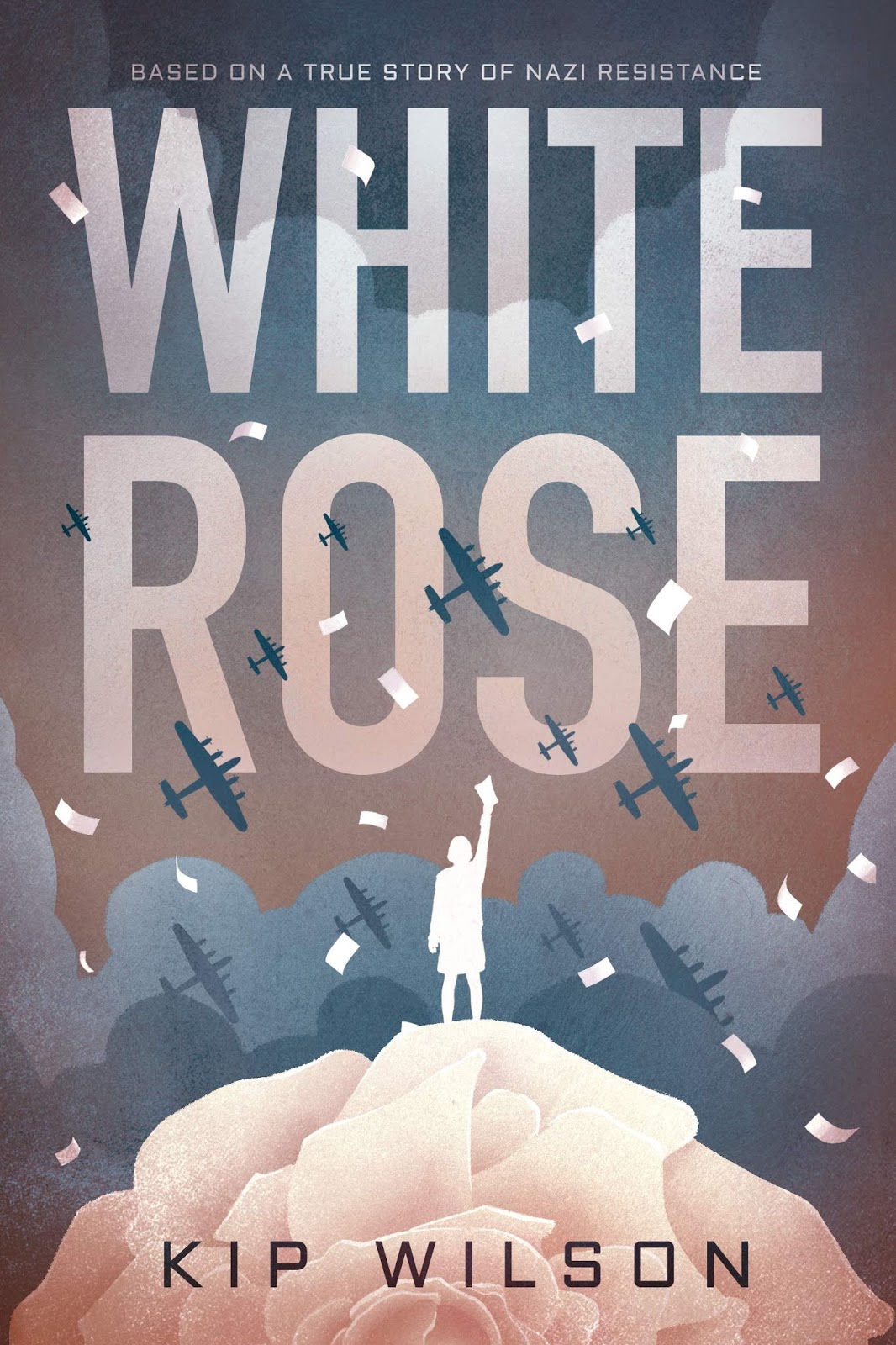
White Rose

Kip Wilson, Author

Versify (April 2, 2019)
ISBN: 978-1328594433

For ages 12 and up

Purchase at Amazon.com
Purchase at Barnes & Noble
Purchase via Indiebound.org


SYNOPSIS

Disillusioned by the propaganda of Nazi Germany, Sophie Scholl, her brother, and his fellow soldiers formed the White Rose, a group that wrote and distributed anonymous letters criticizing the Nazi regime and calling for action from their fellow German citizens. The following year, Sophie and her brother were arrested for treason and interrogated for information about their collaborators. This debut novel recounts the lives of Sophie and her friends and highlights their brave stand against fascism in Nazi Germany.


A PEEK INSIDE

SELFLESSNESS
Letter to Fritz, June 1940

Dear Fritz,

People shouldn’t be
    ambivalent
about the world around
them simply because
everyone else
is ambivalent.

People who
    refuse
to open their eyes
are more than ambivalent—
they are guilty.

How can we expect
    justice
in this world
if we’re not prepared to
sacrifice ourselves
for what’s right?


Copyright © 2019 by Kip Wilson, used by permission of Houghton Mifflin Harcourt.


ABOUT THE AUTHOR


Kip Wilson is the Poetry Editor of the Young Adult Review Network and holds a Ph.D. in German Literature. In 2017, she won the PEN/New England Susan P. Bloom Discovery Award, and her work has appeared in several children’s literary magazines.


CLASSROOM CONNECTIONS

Why is bringing poetry into the classroom important?

Poetry is a form of writing and reading, but it’s also a form of art. It’s a great way to get kids to notice the world around them and to say more with less. Because poetry is generally less wordy, it’s also a great way to engage less enthusiastic readers. They’ll find they can make it through an entire novel in verse with much more ease than a comparable prose novel, giving them a sense of accomplishment. Also, with so many easily definable forms of poetry to try out, everyone can write something.

How might your book be incorporated into an educational curriculum?

Because White Rose is a historical novel based on true events as well as a novel in verse, it fits in well both to the ELA and Social Studies curricula. My publisher created a fantastic educator guide (available at http://www.kipwilsonwrites.com/wp-content/uploads/2019/02/WhiteRose.NotBeSilent.pdf), which can be used to teach White Rose alongside We Will Not Be Silent, an award-winning work of nonfiction about the group. Beyond all that though, the message of the White Rose to speak up for marginalized groups is an especially important one today for teens getting involved in social justice.

Can you suggest a specific classroom exercise related to your book?

I loved Nikki Grimes’ book One Last Word, in which she uses lines from poems from the Harlem Renaissance to create new, timely poems using the Golden Shovel poetic form. In a Golden Shovel, each line in the new poem ends with a word from the original poem, so that, for instance, each of the words in Jean Toomer’s line, “Thunder blossoms gorgeously above our heads,” from “Storm Ending” appear as the last words in each line of Nikki Grimes’ poem, “Truth.”

Students should use the first line from the above poem from White Rose to create a Golden Shovel poem of your own, so that each line ends with the following words:

people
shouldn’t
be
ambivalent
about
the
world
around
them
simply
because
everyone
else
is
ambivalent

What is a simple, practical tip for teachers when it comes to incorporating poetry in the classroom?

I love “The Slowdown” podcast with Traci K. Smith. She delivers a bit of commentary along with a poem (each weekday by a different author) that forces me to take five minutes out of my day to slow down and listen and reflect. I love that it arrives in my inbox in the morning right as I’m getting ready for my day. The content of this particular podcast is aimed at adults, but the idea would transfer well into the classroom: once everyone’s settled at their desks to begin the day, give them a little commentary and then read them a poem.

Can you recount a specific instance of when poetry impacted a student or group of students in a positive way?

I have been loving the reactions around the country to students reading The Poet X by Elizabeth Acevedo. This award-winning novel in verse is revolutionary in so many ways. I’ve seen Elizabeth perform her poetry, so I can attest to the way her words energized the entire audience, but more than that, the way she was able to get her own experience on the page for girls like her to be able to see themselves is simply incredible. What a way to empower students! 


CONNECT WITH KIP WILSON

Website: http://www.kipwilsonwrites.com/
Twitter: https://twitter.com/kiperoo
Instagram: https://www.instagram.com/kipwilsonwrites


Please help me thank Kip for participating in our Classroom Connections series for National Poetry Month by leaving a comment below.

* * * * * * * * * * * * * * * * * * * *

Check out the other Classroom Connections posts and giveaways on offer this month by clicking the names below!

  • Eric Ode (Otters, Snails and Tadpole Tails: Poems from the Wetlands)

Digital art © 2018 by Miranda Barnes,
based on a line from "Ghazal" by Tracy K. Smith.


TO FOLLOW:

The best way to keep up with the Classroom Connections series is by subscribing to Today's Little Ditty via email, which you can do in the sidebar. I will also be announcing the posts on social media. Like me on Facebook and/or follow me on Twitter (also in the sidebar) to stay informed that way. Catch up with Classroom Connections posts you may have missed by clicking on the "It's time to INSPIRE" icon in the sidebar, or by visiting my "Poetry in the Classroom" board on Pinterest.

Thursday, May 18, 2017

Book Love: TOO MANY FRIENDS (Giveaway!)


KATHRYN APEL

Today I'm singing the praises of an Australian children's poet and author whose books we don't see enough of here in the States. That's going to have to change.

Kathryn Apel (Kat to those of us who follow her blog) is a born-and-bred farm girl who’s scared of cows. She lives with her husband and two sons among the gum trees, cattle and kangaroos on a Queensland grazing property, and is the author of five books for children, including three novels in verse.


Kat loves pumping poetry because she can flex her muscles across other genres, to bend (and break) writing rules. She also teaches part-time and shares her passion for words at schools and festivals. There's lots to explore at Kat's website, including information about her books, kid's stuff, kidlit tips, useful links, and a "whisker of poetry."

Order paper copies via the publisher
or the Kindle edition via Amazon.com.
Watch the trailer HERE.
Too Many Friends (UQP, 2017) is Kat's latest novel in verse for young readers. It tells the story of a Tahnee, a second grader who prides herself on having lots of friends, and who loves to spend time with them all... even the ones who can be bossy. But sometimes she gets frustrated. She feels pushed and pulled in too many directions and doesn't understand why her friends can't get along with each other. Tahnee's efforts to strike a balance and keep the peace—to be inclusive, thoughtful, and understanding in and outside of the classroom—make her an ideal role model. Although she recognizes faults, she chooses to celebrate strengths instead, and she shows readers how to be a good friend in a way that's not preachy or show-offish.

For me, reading this novel brought back a flood of memories from my own kids' early years in Sydney. But even without the first-hand memories, there's much to be gained by reading this book. The fact that American children may not be familiar with honey crackles, or know that fairy floss is another name for cotton candy, or have played pass the parcel at birthday parties, won't stop them from identifying with the characters. Besides, there's great value in children (and adults) gaining insight into what it's like living in another part of the world, don't you think? We live in a global society; why not introduce our children to their "neighbours"?

In Australia, my little ones were proud
to wear their school uniforms.
My son was Tahnee's age when we left Australia to return to the US. Although their transition to the Florida school system wasn't perfect, when it came to friendship, there were few differences between these two cultures from opposite sides of the planet. Slightly older children will relate to Too Many Friends, as well. When my daughter was in fourth grade, she had her first run in with what it's like to have... and then lose the attention of a close friend she'd had since first grade, a friend who suddenly became popular.  It wasn't fun—there were many hurt feelings. But to be fair, the popular girl never asked to be "fought over."

The push and pull of friendship is something young readers will relate to no matter where they call home. I can so easily see this book being read aloud in the classroom to help navigate playground dramas, learn what it means to be a good friend, and discover how to get along with others regardless of whether or not they are friends. My children may have missed out on Miss Darling's classroom, but if you'd like to bring Tahnee and her friends into your classroom, check out the additional resources at Kat's website, including downloadable Teachers' Notes and activity suggestions.

For now, though, please help me welcome Kathryn Apel to the TLD classroom!


Thanks so much for joining us, Kat!

Tell us a little about your experience of writing TOO MANY FRIENDS. What drew you to the story and why did you choose a novel in verse format?

A friend was sharing her mother-heart, about her young daughter who was perpetually wearing herself ragged trying to always be a good friend and meet the needs of all her friends, so that her friends were almost a burden for the little girl to bear.

I’m sure at some stage we’ve all looked at the popular kids and wished a little, but I’d never considered that lots of friends could be a ‘difficult' thing. I wrote a note on my phone; ‘a story about too many friends’ … and started writing it soon after. The words flowed. I think I’d finished my first draft in under a month. The editing process was also so much quicker/easier than my previous verse novels. (Just as well, since we had an unscheduled and exciting holiday opportunity in the middle of that.) I think writing this one from the teacher-heart, as opposed to the mother-heart, perhaps enabled this… and all those wonderful years in the classroom!

It was always going to be a verse novel. I’m finding it hard not to write in verse these days. Partly because words seem to have more resonance in the verse novel format—like they’re buffed and polished and warmed to a golden glow, and there's nowhere for superfluous words to hide. But also because the stories that I’m needing to tell are stories that have heart, and the verse novel seems to be the right way to engage readers in those stories.


In the United States, novels in verse are on the rise, while children's poetry collections seem to be less marketable. What is your overall sense of the children's poetry and verse novel markets in Australia?

*Snap!*

It is so hard to get poetry published in Australia! But as you’ve noted in terms of America, there is a growing number of publishers who are taking on verse novels here—which is, of course, a good thing! My publisher, University of Queensland Press (UQP), has long been a champion of the verse novel, publishing Steven Herrick’s collection of novels in verse and Margarita Engle’s Silver People amongst others—including my three.

Kat makes some new friends at a recent book event.


How is poetry viewed in the Australian educational system? Is it embraced, or is it more like here in the States, where teachers are generally uncomfortable teaching poetry?

Funnily enough, I was surprised by your questions/comments about poetry in education, because for as long as I’ve been involved in Poetry Friday, I’ve (a little jealously/yearningly) had this really lovely, rosy view on poetry in America. But apparently Poetry Friday isn’t an accurate reflection on the education system and its approach to poetry as a whole?

What is it that shakes up our confidence with poetry! Kids are drawn like magnets to rhythm and rhyme. What happens along the way, to turn poetry into ‘the baddie’?

Because yes, in Australia poetry is also seen as an intimidating subject. People worry that they don’t really ‘get’ what the poem is about. Or the curriculum requirements make the analysis of poetry arduous, not magical. Or the poems studied don’t relate to kids of today. It’s about right and wrong answers, not joyful word play and experimentation.

More and more I’m realising that poetry is not about one right meaning. It’s about how it makes you feel—when your heart skips… or lurches—and the feel of the wordplay rolling around in your mouth. It’s about creativity and discipline, wordplay and writing muscle, engaging and enabling a wide range of abilities.

I keep hoping that this giant penny will drop—people will realise that poetry is such a HUGE and diverse genre, and there really is a form of poetry for every person and every occasion. Just because one form doesn’t resonate, another one will! You may not love all forms of poetry—and that’s okay! You can still enjoy poetry! :)


In a blog post, you describe TOO MANY FRIENDS as your "most joyous book." How did writing it compare to your previous novels in verse? Was there anything that particularly caught you by surprise?

Bully on the Bus follows the story of Leroy, a small boy who is bullied throughout the book, on his school bus. There is sadness and anxiety throughout the book, and whilst Leroy is ultimately empowered, that’s towards the end of the book. It's an important story, very much a story from the heart, and I love what it has the potential to do for kids who are being bullied—but there are more tears than laughs in that book.


Similarly, On Track deals with sibling rivalry, self-doubt and imperfect bodies. As one brother’s story takes a turn for the better, the other’s takes a twist for the worse. There are light moments throughout, but there is also a lot of the angst that comes with those themes.
  

Too Many Friends is about a sweet, caring girl who just wants to please—and constantly tries to find ways to be a friend to everyone. (Perhaps my biggest ‘problem’ with this book (through the editorial process) was getting rid of excess ‘smile’s. :) ) Yes, there are points of conflict—and there are moments that catch your heart—but Tahnee’s story is mostly a joyous story.


Please share a favorite selection from TOO MANY FRIENDS and tell us why it's meaningful to you.

So many of the activities in Tahnee’s classroom are things I’ve done with classes I’ve taught, and collage picture books are up there are as one of my favourites!

(Click images to enlarge.)


From Too Many Friends by Kathryn Apel (UQP, 2017), used by permission of the author.

One of the best parts of the project is that buzz of energy and enthusiasm as ideas and edits bounce around the room—kids engaged and enthused with a purposeful real-world project.

Sometimes, with all the standardised assessments and increasing curriculum demands, that joy of shared teaching and learning is squeezed out of classrooms. A teacher’s passion counts for everything within the classroom! If Too Many Friends helps to validate or reignite that passion and enthusiasm—for kids and teachers—that would be a beautiful thing!


What's coming up next for you?

There are works in the pipeline that I can’t yet discuss… but can’t wait until I can share!

In terms of current works in progress, I have a number underway, including something a little different, for me: a historical verse novel for middle grade/young adult, inspired by our recent trip to Antarctica. So amongst the fun of new book release and all that involves, I have also been delving deep into research. And thanks to different posts from Poetry Friday members, I’ve jumped in at different story points to play with some of the poetic forms I’ve seen on the rounds. I’ve not approached a story quite like that before, but I’m having lots of fun! And so far it’s been working. So not only is the historical genre new for me, but so too are many of the poetry forms.


Sounds exciting, Kat! Keep us posted. And thanks for traveling all the way here to be with us today. :)

Thank you so much for having me visit, Michelle. Today’s Little Ditty is like a virtual playground and gym rolled into one. You do a great thing here!


Speaking of great things . . .


Since it's not so easy to grab a copy of Too Many Friends at your local US bookstore, I'm giving away the copy I was sent by University of Queensland Press to one lucky reader of today's blog post! All you need to do to enter the giveaway is leave a comment below or email me at TodaysLittleDitty (at) gmail (dot) com. Make sure you do so no later than Tuesday, May 23rd. The winner, selected randomly, will be announced next Friday.

** Sorry. This giveaway is now over. **


I sure am enjoying the wide variety of poems for Melissa Manlove's challenge to write about how writing (or a book) is like something else! This week's featured ditties included poems by Jesse Anna Bornemann, Diane Mayr, Elizabeth Steinglass, and Irene Latham. Linda Mitchell is sharing hers at A Word Edgewise today. Post your contribution on our May 2017 padlet to be included in next week's wrap-up celebration!


Join Kiesha at Whispers from the Ridge to discover everyday gifts and explore this week's Poetry Friday roundup.