Showing posts with label David Elliott. Show all posts

Thursday, April 25, 2019

Classroom Connections with David Elliott


TODAY'S READ

Voices: The Final Hours of Joan of Arc

David Elliott, Author

HMH Books for Young Readers (March 26, 2019)
ISBN: 978-1328987594

For ages 14 to adult

Purchase at Amazon.com
Purchase at Barnes & Noble
Purchase via Indiebound.org


SYNOPSIS

Told through medieval poetic forms and in the voices of the people and objects in Joan of Arc’s life, (including her family and even the trees, clothes, cows, and candles of her childhood), Voices offers an unforgettable perspective on an extraordinary young woman. Along the way it explores timely issues such as gender, misogyny, and the peril of speaking truth to power. Before Joan of Arc became a saint, she was a girl inspired. It is that girl we come to know in Voices.


A PEEK INSIDE

© 2019 by David Elliott, from Voices: The Final Hours of Joan of Arc (HMH Books for Young Readers)


ABOUT THE AUTHOR

Read David Elliott’s spotlight interview
on Today's Little Ditty HERE.

David Elliott is the author of over twenty picture books and novels for young people, including The New York Times bestselling And Here’s to You!. Other books include The Transmogrification of Roscoe Wizzle; Finn Throws a Fit; Baabwaa and Wooliam; the This ORQ series; and the poetry series On the Farm, In the Wild,  In the Sea, On the Wing and In the Past. His YA novel in verse Bull (2017) garnered six starred reviews and has been compared to Hamilton. Voices: The Final Hours of Joan of Arc was released in March of this year. Before becoming a writer, David worked as an olive picker in Greece, a popsicle stick maker in Israel, and a singer in Mexico. He is a founding member of Lesley University’s Low Residency Program in Creative Writing, where he still teaches. Currently, David lives in New Hampshire with his wife and Dandie Dinmont terrier, Queequeg.


CLASSROOM CONNECTIONS

Why is bringing poetry into the classroom important?

Well, this is like asking why it’s important to bring math into the classroom, right? And I love that the question refers to bringing poetry into the classroom, rather than teaching it. Bringing poetry to young people is an act of love. If we’re not very careful, teaching it is like refusing to give a starving kid dinner until she can recite every ingredient that went into its preparation. There are so, so many reasons to get poetry into the ears and mouths and hearts of our younger citizens. Here is just one. Right now we’re all about STEM. It’s all STEM all the time. Hooray! We get it. STEM! STEM! STEM!

Yes, of course, we need great engineers, great doctors, great astronomers and mathematicians and coders. Nobody is arguing that we don’t. But if we’re going to get anywhere in this weary world we need engineers who can feel, doctors who can empathize with their patients, astronomers who can communicate the wonders of the universe to the rest of us, and mathematicians and coders who are firmly grounded in notions of what it means to be human. I can’t think of any better way to give our young women and men these skills than to sustain them with poetry. Carl Jung once defined a symbol as the best representation of that which cannot be represented. I think that’s an excellent definition of a poem. Of course, we can’t duplicate the experience of grief, or love, or jealousy, or rage, or astonishment, or confusion or any of it through metaphors, and syntax, and line breaks. But we can get close. And when we do, we get closer to all the human beings with whom we share the planet.

How might your book be incorporated into an educational curriculum?

I can think of many curricula where Voices: The Final Hours of Joan of Arc might be an appropriate text. Medieval and European History, Women’s and Gender Studies, Creative Writing Classes. Mary Ann Cappiello, professor of language and literacy at Lesley University, did an excellent job of putting together a curriculum for a Women’s History and Gender Studies course. You can find it in School Library Journal’s “The Classroom Bookshelf.”  Here’s the link: http://www.theclassroombookshelf.com/2019/03/exploring-womens-history-and-gender-perspectives-through-voices-the-final-hours-of-joan-of-arc/

I’d love to see someone do a unit asking students to write their own biographies using the structure of Voices. First, allow the kids to get two or three of the forms used in the book under their belt. Then ask them to tell their lives through poems from the perspective of people who know them, as well as inanimate objects that mean something to them—bikes, helmets, barrettes, keyboards, violins, whatever. I might also ask them to pick one voice—in Voices, it’s Fire—that repeats throughout their biography.

Can you suggest a specific classroom exercise related to your book?

WRITING A TRIOLET (TREE-o-lay)

French. Dates from thirteenth century.

WHAT YOU NEED TO KNOW
  • Eight lines
  • The first and second lines form an unrhymed couplet.
  • The end words of lines one and two set the rhyme scheme.
  • Lines 1,3,5,7 rhyme. As do lines 2,4,6,8.
  • Line one is repeated at lines four and seven.
  • Line two repeated at line eight. In other words, the first two lines of the poem are also its last two lines.
Lines can be any length, but rhyming lines are of the same length.

LET'S TAKE A LOOK
How Great My Grief


How great my grief, my joys how few,
Since first it was my fate to know thee!
Have the slow years not brought to view
How great my grief, my joys how few,
Nor memory shaped old times anew,
Nor loving-kindness helped to show thee
How great my grief, my joys how few,
Since first it was my fate to know thee?

     – Thomas Hardy (1840-1928)
YOUR TURN

Take a look at “The Arrow” on page 124 in Voices: The Final Hours of Joan of Arc. Though it has been shaped to form a concrete poem, it is, in fact, a triolet. Following the guidelines listed in the bullet points above, write a triolet in the voice of an object from your own life.  What does it have to say about you?

What is a simple, practical tip for teachers when it comes to incorporating poetry in the classroom?

When I was teaching I often began each session—no matter the content of the class—with a poem. We didn’t discuss it. I didn’t “teach” its meaning or say anything about its structure or the author. I simply read it, was silent for a moment, and then got on with the day’s lesson. Without fail if I forgot, the students—everybody from the shy girl sitting in the front row to the burly quarterback sitting at the back—complained, and bitterly. They didn’t know they needed it, but once they discovered they did, they craved it. Imagine what our country would be like if every day, every teacher from kindergarten through upper level graduate courses in cellular biology read one poem. Every class. Every day. We would be living in a different, a better country.

Can you recount a specific instance of when poetry impacted a student or group of students in a positive way?

In all my school visits I try to write a communal poem with whatever group I’m talking to. Here’s a recent one. Almost all the language of the poem came from the kids, a group of kindergarteners and first grades. They were thrilled.

Owl

I was flying, hunting, searching for prey.
I work by night, I sleep by day.
I turn my neck: I see the mole,
I take it back to my treetop hole.
Hoo! Hoo! Hoo! Hoo!

Years ago, I was teaching a college level intro to creative writing class. When we came to the unit on poetry we read Elizabeth Bishop’s “One Art.” I will never forget the expression on one of the student’s faces when we finished. She looked as if a light were shining on her, or, maybe, as if she had suddenly discovered that she was the light. That is one of my happiest memories, that little moment. And all we did was read the poem. We just read it.


CONNECT WITH DAVID ELLIOTT

Website: davidelliottbooks.com
Instagram: @davidelliott1234
Twitter: @davidelliott10

Look for BULL (click here to read the review on Today's Little Ditty), released last month in paperback.


Many thanks to David for participating in our Classroom Connections series for National Poetry Month, and for offering a copy of Voices: The Final Hours of Joan of Arc to one randomly selected TLD reader!

To enter, leave a comment below or send an email with the subject "Voices Giveaway" to TodaysLittleDitty (at) gmail (dot) com by Tuesday, April 30, 2019. Winners will be announced on Thursday, May 2nd, so be sure to check back to see if you've won!


 * * * * * * * * * * * * * * * * * * * *

Check out the other Classroom Connections posts and giveaways on offer this month by clicking the names below!


Digital art © 2018 by Miranda Barnes,
based on a line from "Ghazal" by Tracy K. Smith.


TO FOLLOW:

The best way to keep up with the Classroom Connections series is by subscribing to Today's Little Ditty via email, which you can do in the sidebar. I will also be announcing the posts on social media. Like me on Facebook and/or follow me on Twitter (also in the sidebar) to stay informed that way. Catch up with Classroom Connections posts you may have missed by clicking on the "It's time to INSPIRE" icon in the sidebar, or by visiting my "Poetry in the Classroom" board on Pinterest.

Thursday, April 20, 2017

Book Love: BULL


DAVID ELLIOTT


We discussed his poetry collection On The Wing (Candlewick Press, 2014) and he challenged us to write letter poems.  (I reposted one yesterday: Damon Dean's "Dear Sir Roly-Poly.") In celebration of National Poetry Month and TLD's birthday, I've invited David back to talk about his new young adult verse novel from Houghton Mifflin Harcourt.

BULL
Houghton Mifflin Harcourt, March 28, 2017
ISBN: 978-0544610606
Find at Amazon.com, Barnes & Noble,
via Indiebound.org, or order a personalized copy.
BULL is based on the Greek myth of the Minotaur. This is not the first time we've met the Minotaur on Today's Little Ditty (thank you, Tabatha Yeatts), nor is it the first time we've focused on mythology. (Remember Marilyn Singer's ECHO ECHO?) But David opens up a whole new labyrinth with this one. (See what I did there?) BULL is edgy, hip-hop, brash, irreverent, dark, complex, sometimes profane, and always extraordinary.

Looking back at the verse novels we've reviewed over the last few months—Stone Mirrors: The Sculpture and Silence of Edmonia Lewis, When My Sister Started Kissing, Gone Camping, and now BULL—there's one thing that's obvious: novels in verse don't come in one-size-fits-all! For goodness sake, it's hard enough to figure out what to call the darn things—verse novel, novel in verse, novel-in-poems, let alone when and where to place the hyphens. While BULL and Stone Mirrors are both considered young adult literature, they're so different in tone and subject matter that it's hard to imagine packing them in the same box. It's true that David takes a similar approach to Helen Frost (When My Sister Started Kissing) in that each character has its own distinctive poetic form and voice, but the similarity ends there. And Gone Camping? Forget it. BULL is nothing like Gone Camping. This book is not for elementary-aged children. Period.

In BULL, the Minotaur is not the monster we've come to expect. Quite the opposite. We feel sympathy for the doomed creature as David fills in the blanks about the Minotaur's birth through teenage years. It's the free-wheeling, gonna-mess-with-your-head-and-couldn't-care-less Poseidon who you need to watch out for! For mythology enthusiasts, that shouldn't come as a surprise. We know that we mortals are merely the gods' playthings, yet to see the damage play out in this novel can be disturbing.


In the words of Poseidon:
Well, Life's not for wimps.
Sometimes gods are gods
And sometimes they're pimps.

In the words of Daedalus, the Royal Engineer: 
     Oh, it's the same

in every corner of the earth:
     the powerful are
irreproachable;
     the rest of us are dirt.

Speaking of Daedalus, the craftsmanship of this novel is remarkable... even the page turns become part of the poetry! David deftly weaves character, poetic form, innuendo, narrative twists and double crosses. And let's not forget David's characteristic wit and wordplay! In this case, it mostly shows up as the bawdy and callous barbs of an arrogant sea god. While I found Poseidon hard to take at times, I appreciate David's explanation in this Horn Book interview:
I know that some folks may be offended by Poseidon’s profanity and also by his disdain for us mortals. To be quite honest, I myself was sometimes taken aback by the sea god. But it wasn’t my job to censor him or send him off for sensitivity training before I allowed him to speak the way he wanted to. That isn’t writing; it’s moralizing. I guess it’s Poseidon’s joke on me that although he is the one with a potty mouth, I‘m the one who has to take responsibility for it.

It's not surprising that BULL has earned six starred reviews—from Kirkus, BCCB, The Horn Book, Booklist, Shelf Awareness, and School Library Connections.  Seven, if you include TLD's ditty-star of approval.

I could say more...


but I think I've blabbed enough. Let's hear from David instead.


Hi David! Welcome back to Today's Little Ditty!
What have you been up to since you were last here in 2015?


It seems like I’m always busy either with the work of writing (which includes many hours of staring idly out the window) or with serving as a mentor for emerging writers. When I finish here, I’m going to take a nap.


Tell us a little about your experience of writing BULL. What drew you to the story and why did you choose a verse novel format?

I’ve always been very curious about that myth. It tells us the circumstances of the Minotaur’s birth, but that’s it. The next thing we learn is that he’s in the labyrinth. Not a word about his childhood or adolescence. What might that have been like for the boy and for those around him? Also, when I discovered that his mother named him Asterion, and that it meant Ruler of the Stars, my heart broke.

ASTERION
AGE 3

Mommy has a little calf.
     Little calf.
     Little calf. 
Mommy has a little calf.
His nose is black as tar.

She calls her calf Asterion.
     Asterion.
     Asterion.
That's my name—Asterion.
I'm Ruler of the Stars.
– from BULL, a novel by David Elliott (HMH Books for Young Readers, 2017)


To have given him a name like that, she must have really loved him. What then made him transform from Asterion into the Minotaur? That is, how are monsters made? Finally, it made me think that each of us has this potential—to become either The Ruler of the Stars or The Minotaur, sometimes both, and that we make decisions about that potential every day. As for choosing to write in verse, I don’t mean to be coy, but I really felt as if the verse chose me. It seemed to me that that is what the book wanted, what it needed.


Was there anything in particular about the process that caught you by surprise?

As I mention in the notes in the book, I chose the poetic form for each character rather impulsively, without really knowing what I was doing. (NOT the way to write a book, by the way.) What was surprising—and kind of wonderful—was to watch how the respective forms shaped the characters. In a way, the forms wrote the book.


Please share a favorite selection from BULL and tell us why it's meaningful to you.

Poseidon’s irreverent passages were very liberating. But I have a personal connection to his lyrical description of Crete at the book’s beginning. Many years ago, I lived on Crete, first, picking olives high up in the interior mountains, and then washing cucumbers in a coastal town. I’ll never forget those rare experiences or the incredible, primal beauty of that island.

In these lines, Poseidon is explaining that Minos is a man with no imagination and therefore cannot be moved by the island’s beauty.

. . . But it’s not the friggin’
Scenery this friggin’
Minos has in mind.

Not the harbors or the shores,
The god-possessed waters.
Not the sheep, the trusty shepherds,
Their warlike sons, their lusty daughters.
Not the olives or the figs,
The sacred long-lived trees.
Not the amber honey
Or the honey-making bees.
Not the thyme-drunk lovers
Who sigh among its flowers.
No,
All this clown wants
Is a little power.

What's coming up next for you?

I’m very happy to say that I have quite a few things in the pipeline. This fall, Candlewick will release a new picture book, Baabwa and Wooliam, illustrated by the one and only Melissa Sweet. It’s about as different from BULL as you could imagine. Picture book. Prose. Sweet. I’m super excited about it. Then the following spring, we’ll have another in the poetry series. In the Past. Dinosaurs etc..  All I can say is, Matthew Trueman is amazing. I have recently signed up In the Woods, illustrator to be announced. Familiar woodland animals. And then with Beach Lane, a very young picture book, Red Big, Red Small. My agent, the great Kelly Sonnack, is currently pitching another YA novel in verse. It’s based on an historical figure, and is very different from BULL. No f-bombs. (I don’t know if I’m happy or sad about that.)


Well, David, we're certainly happy that you stopped by today to shoot the bull with all of us! (You know you saw that coming!)


If you want to write a letter poem for our Ditty Potluck, I'd love to see it!  Or, if you'd rather, choose from any of the other 27 DMC challenges. Post your poem on our April 2017 padlet and be sure to indicate which challenge you are responding to.  All contributions will be included in a wrap-up celebration on Friday, April 28th. Individual poems shared this week were by David L. Harrison, Rebekah Hoeft, Jone Rush MacCulloch, Damon Dean, and Linda Mitchell at A Word Edgewise.

Tabatha Yeatts is welcoming busloads of poets to The Opposite of Indifference this week. Join her for the Poetry Friday roundup.


If you're looking for other ways to celebrate National Poetry Month, Jama Rattigan is your go-to for NPM festivites at Alphabet Soup.


Thursday, February 5, 2015

Spotlight on David Elliott + DMC Challenge


DAVID ELLIOTT
          Photo: Michael Seamans

David Elliott is the author of many picture books and novels for young people, including The New York Times bestselling And Here’s to You!. Other books include The Transmogrification of Roscoe Wizzle; Finn Throws a Fit; this ORQ. (he cave boy.); and the poetry series, On the Farm, In the Wild, In the Sea, and On the Wing. Among the many honors his books have received are The International Reading Association Children’s Choice Award, Bank Street College Best of the Best, Chicago Public Library Best of the Best, New York Public Library Best Books for Children, ALA Notable, and the Parents’ Guide to Media Award.  Currently, David has eight books in production, including a YA novel in verse to be published by Houghton in 2017.  He lives in New Hampshire with his wife and their Dandie Dinmont terrier, Queequeg.

When I approached David about being on the blog, I couldn't decide whether I wanted to feature his delightful picture book, this ORQ. (he cave boy.) (who wouldn't want a woolly mammoth to love this Valentine's Day?) or On the Wing, his captivating children's poetry collection about birds. I presented the options to David and hoped he wouldn't come back with, "Whatever you want is fine, Michelle." He chose On the Wing. Crisis averted.

ON THE WING
Candlewick Press, September 2014
ISBN: 978-0763653248
Click HERE* to order.

*Note from David: "I'd be happy to personalize. In the
comment section, folks should write DAVID ELLIOTT
and also how they'd like the book signed or inscribed.
For example, 'Book–On the Wing' 'Inscription–to Michelle'."


So now I am privileged to tell you all about this gorgeous book of bird poems! I've always liked birds... until I lived in Australia. Then I fell in love with them. Truly. Madly. Deeply. In love. Trust me, the birdsong alone is worth the cost of airfare. David included two Australian birds in this 16-poem collection – the bowerbird and the Australian pelican – as well as other backyard and more exotic favorites. As it happens, neither of the Aussie birds David chose to write about have much of a singing voice, but they are interesting characters nonetheless. The bowerbird is more of a mimic than a singer. My husband likes to tell the story of one who sounded just like a truck changing gears while going uphill. The pelicans we came across preferred to chomp down on little girls' fingers. Had David known about the run-in my daughter had on her third birthday, his poem might have turned out differently.... but I digress.

Even if you're not a birdwatcher, a bird-listener, or any other type of bird enthusiast, after reading this collection you will, at the very least, have newfound respect for their different personalities.  David's poetry makes certain of that.  His wit and wordplay combine with a detailed focus and competent understanding of avian character to create short verse that is concise, graceful, amusing, and unforgettable. Becca Stadtlander's glorious illustrations are also vivid and absorbing, as she expertly reflects the character and tone of each bird and poem. The result is an engaging collection that children will ask for again and again.

Delighted to have you join us at Today's Little Ditty, David! 

Shall we get started? I expect TLD fans know the routine by now. We always begin with five favorites:

Favorite Childhood Memory:  
Playing Ghost in the Graveyard (a kind of backwards hide-and-seek) with the Defenbaughs, the Piatts, the Kennedys.
Favorite Music:  
Mozart, especially the operas. And Handel’s vocal music. But I love a good folk song, too. And old Broadway tunes. (I’m so not cool.) Gershwin. Noel Coward. Those guys. I grew up singing Baptist hymns. I learned about meter and rhyme from those beautiful, old songs.
Favorite Quote:  
Was it Katherine Paterson who wrote that living well is harder than writing well? 
Michelle: Yes, that's right. Here's the quote from Katherine Paterson's Gates of Excellence: On Reading and Writing Books for Children:
“If we marvel at the artist who has written a great book, we must marvel more at those people whose lives are works of art and who don't even know it, who wouldn't believe it if they were told. However hard work good writing may be, it is easier than good living." 
I love the inherent sense of perspective in that, and the implied warning about keeping one’s ego in line. 

A quote I always share with my students at Lesley’s Low Res MFA Program in Creative Writing is from the great E. L. Doctorow: 
"Writing is like driving at night in the fog. You can only see as far as your headlights, but you can make the whole trip that way."
Recently, I've been thinking of a quote a friend sent me. It's by Wallace Stegner: 
“…it is a reduction of our humanity to hide from pain, our own or others.”                                                                                                                                               
Favorite Poet: 
I love the work of Wislawa Symborska. My favorite of hers is, “A Little Bit About the Soul”. 
Recently, I’ve been on a Richard Wilbur kick. Here is 
Flying

Treetops are not so high
Nor I so low
That I don’t instinctively know
How it would be to fly
(Read the whole poem at The Writer's Almanac)                                         
Favorite Book: 
It would be impossible for me to say which book is my absolute favorite, but the children’s book I think comes closest to perfection is TUCK EVERLASTING.  There is so much to admire (and emulate) in this little masterpiece. 

First, its craft. The Prologue alone is a master class in what writing can be, what it can do.  And then there is that central image of the wheel. I’m astounded at the way the book’s architecture supports this image. It begins on the road into Treegap and concludes on the same road, but this time, we are leaving. In other words, Babbitt has structured the narrative itself as a rolling wheel. It’s genius. 

But more than that, I love what I perceive to be Natalie Babbitt’s intention in the book. I think it was Lewis Carroll who described fairy tales as “love gifts”. For a long time, I puzzled over what that might mean. Love gift. And then it hit me. One of the reasons fairy tales have stayed with us for so long is because they give us a choice. We can read them as stories. (This happened. Then this happened. Then this happened. ) And though the stories often strike us as weird – She turned into a what? – they always satisfy. But when we’re ready we can also read them as comforting and honest (a difficult combination) symbolic expressions of great human truths.  Natalie Babbitt gives us this choice in TUCK, at its heart an extended fairy tale. We can read it as an exciting story about a girl and the fountain of youth. Or, if were ready, we can read it at a much deeper level, taking from it a beautiful, but solemn truth about the human condition. TUCK is surely a gift of love, a love gift.

What inspires you to write for children and/or what do you enjoy most about being a children's author?
This is a difficult question because the truth is I don’t know. If we want to take a psychological route, perhaps we might find an analogy in the wisdom of Emily Dickinson. “Mirth is the mail of anguish,” says she. But let’s not take that route. Let me just say that I feel incredibly privileged to do what I do, and take as seriously as I know how the immense responsibility of writing for people who are still developing physiologically, psychologically, emotionally, spiritually.

"I feel incredibly privileged to do what I do..." –David Elliott

The Great Sendak once famously said that he didn’t write for children. He just wrote and then someone told him who it was for.  As much as I admire The Master – and make no mistake about it, I do – I find this disheartening. What is wrong with saying outright that we write for kids?  Are we afraid the world won’t consider us real writers? And so what if it doesn’t? I sometimes wonder if the entire industry hasn’t become infected with an inferiority complex.

Uh-oh. I can feel myself going into Crackpot Mode. Next question, please.

You have amazing versatility as a storyteller. Last fall you had three children’s books released within six weeks of each other: a poetry collection: On the Wing (Candlewick Press); a picture book: this ORQ. [he cave boy.] (Boyds Mills Press); and a young adult novella: Forever and Ever (GemmaMedia). What is your secret to juggling different projects simultaneously?
Attention Deficit Disorder? ( I might not be kidding.)

What was the biggest challenge you faced in writing On the Wing?
Each of the books in the poetry series (one more on its way) has presented a different set of challenges.  I can think of three right off the bat for ON THE WING.
1) In my feeble imagination, all birds had the same set-up. Beaks. Feathers. Wings. Real, real interesting. 
2) There are so many of them! How to choose fewer than twenty? 
3) I knew nothing – and when I say nothing, I mean nothing, no thing! – about birds. But then, as I began to read and watch and listen to them, both in my yard and on YouTube, etc., they all became interesting. This compounded my difficulties greatly.
In the end, I chose the birds based on a couple of criteria. The first was very personal: The bird had to get to me in some way. I don’t know how to explain this really except to say that if I were going to write about it, I had to have something I wanted to say, a feeling I could shape into words. I also kept in mind something my great editor for the series, Elizabeth Bicknell, said when we were working on the second book, IN THE WILD. We were talking about the poem for the zebra, the first iteration of which focused on guess what? Stripes. “Stripes?” Liz said with an inflection that only the British seem to be able to pull off. “Oh, David! Can’t you think of anything new to say?” This was tough to hear, but very, very smart. This idea, then, became my benchmark, trying to say something new, or at the very least, in a new way.

IN THE WILD, text © David Elliott, illustration © Holly Meade (click to enlarge)

As lovely as the antelope,
as lovely and as fast,
but Antelope
is always first
and Zebra always last.

They say that's just the ordered way,
unchangeable, and yet
I wish we had, 
for Zebra's sake,
a different alphabet.

               ~ David Elliott, In the Wild

The second criterion was easier. I wanted to be sure to give the illustrator plenty to work with. That meant selecting birds of various sizes, varying plumage, different environments and habits.  While we are all heartbroken to lose Holly [Holly Meade, Caldecott Medalist and illustrator for ON THE FARM, IN THE WILD, and IN THE SEA, who passed away in 2013], I want to say that Becca did a beautiful job. I couldn’t be happier with the illustrations.

But the poems are not just about birds. They are also very much about language. I wanted to demonstrate for children the power, the beauty, the resilience, the playfulness, the extravagance, the economy of their language. I wanted to imply that there is meaning, too, in what isn’t said. I wanted to show children how  malleable their language is, how it can be shaped into a form, and how the form itself can have meaning. All that and more. It’s up to others to judge how successful I’ve been, but that’s what I was striving for. It’s what I’m always trying to do.

Would you share a selection from On the Wing? 
Here's "The Cardinal," in honor of Valentine's Day:

ON THE WING, text © David Elliott, illustration © Becca Stadtlander (click to enlarge)

The Cardinal

He's a hotshot
valentine.
She's a Plain Jane.
But one without
the other . . .
a song with no refrain.

               ~ David Elliott, On the Wing

If you were a bird, what kind would you be?
Well, I’m afraid of heights, so I wouldn’t be one of those majestic, soaring types. And I’m a homebody, so nothing too exotic. I love crows, their intelligence, their assertive blackness. But that voice! That’s a problem. (I wanted to be an opera singer.) Some of my smart-aleck friends – they’re all smart-alecks, by the way – might suggest a mockingbird. I wouldn’t mind that really because of the way those lovely birds sing. And sing. And sing.

What’s coming up next for you?
Currently, I have eight books in various stages of production. All of them coming out in the next two or three years. I’m also working on a novel in verse that will be published by Houghton in 2017.  It’s one of those outside-the-box projects, so I feel very, very fortunate to have signed it up with the brilliant Kate O’Sullivan at Houghton. (Also thank you to my incredible agent, Kelly Sonnack at ABLA.) I’m just finishing up a middle-grade novel that I’ve been working on in one way or another for about five years, and I always have a picture book or two  rattling around in my head. I’d like to do a book of ghost stories one day.  Eventually, I’d like to get around to some creative nonfiction for adults.


David Elliott's "novel" beginning

"I was in the first grade. I wish I had that
shirt today.  (Note comb in pocket.)
That snazzy haircut, by the way, was called
The Pineapple."
If you had all the world’s children in one room, what would you tell them?  

The responsibility of such a thing is almost beyond the powers of my imagination. I guess I would tell them that each of their lives is a like a book with a beginning, middle and end. I would say that like any book, some of the chapters will be wonderful and, like any book, some of the chapters will be difficult. I would tell them to expect surprises, all kinds of surprises, big and small, welcome and otherwise. I would tell them to have hope, especially when the situation seems hopeless. And I would suggest that a sense of humor can get them through almost anything. I would tell them that kindness is a strength and that courage is sometimes silent. I would tell them to take each other's hand and not let go.


... hmm? Oh, sorry. I was cleaning up the mess from where my heart melted all over the floor. All set now. Please tell us what you have chosen as this month’s ditty challenge.
A Letter Poem. Write a letter to a bird, an animal, an object of your choice. The letter may be one of affection, of inquiry, of complaint. It should look like a letter with a salutation, closing and signature, but internally should follow a rhyme scheme of your choice. Research your chosen topic first, even if it is as familiar to you as a spoon. Often, it is some quirky piece of information that will point you in the right direction. As an example, you might want to look at "The Orangutan" from IN THE WILD: 
Dear Orangutan,

Three cheers to you, man of the forest.
You arrived here long before us.
You paved the way; you saw it through.
How nice to have someone like you
sitting in our family tree.

Sincerely, from your cousin,
Me
In that poem, "man of the forest" is an English translation from the Malay orang utan. Good luck!
And they say letter writing is a lost art. Pshaw! Sounds to me like another great DMC challenge!

Ready poets? 
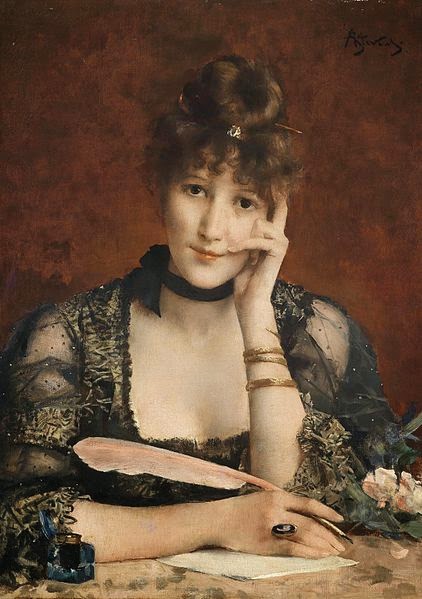
Grab your quill and parchment...

The Letter, Alfred Stevens, Public Domain

I eagerly await your replies.

Throughout the month, send your letter poems to TodaysLittleDitty (at) gmail (dot) com or use the contact form in the sidebar to the right. For children under 13 who would like to participate, please read my COPPA compliance statement located below the contact form.

TO MY BLOGGER FRIENDS:
Thank you for publishing your poems on your own blogs– I love that!  Would you also please send me a copy of your poem or a direct link to your post? That way I know I won't miss it, and I also know that I have your permission to post on Today's Little Ditty.

Some poems may be published on the blog as daily ditties, but all of them will appear in a wrap-up post on February 27th, 2015. And, yes, your wish is my command. As extra incentive, David has generously offered a personalized copy of On the Wing to one lucky participant, chosen randomly at the end of the month!

Thank you for sharing your thoughts, insights, and personality with us today, David. It's been such a pleasure to interview you!

* * * * * * * * * * * * * * * * * * * * * * * * * * * * * * * * * * *

Allow me to extend one more THANK YOU to everyone who participated in last month's ditty challenge, brought to us by Joyce Sidman.  The turnout was fantastic and the Deeper Wisdom poems were truly inspired!

Random.org has determined that the winner of WINTER BEES & Other Poems of the Cold by Joyce Sidman and illustrated by Rick Allen is: 

KATIE GAST  – congratulations Katie!


Today's Poetry Friday roundup is being hosted by the talented Liz Steinglass.