
 |
| JEANNINE ATKINS |
Jeannine Atkins is the author of several picture books, chapter books, and novels for young readers, about courageous women who forge ahead in their lives and careers despite formidable odds and personal sacrifice. She has distinguished herself as a critically acclaimed poet with her biographical novels-in-verse Borrowed Names: Poems About Laura Ingalls Wilder, Madam C. J. Walker, Marie Curie, and Their Daughters (Henry Holt & Co., 2010), Finding Wonders: Three Girls Who Changed Science (Atheneum Books/Simon & Schuster, 2016), and her latest, Stone Mirrors: The Sculpture and Silence of Edmonia Lewis (Atheneum Books/Simon & Schuster, 2017).
When she's not writing, Jeannine teaches children's literature at the University of Massachusetts Amherst and writing at Simmons College. As much as I'd love to sit in on her classes, I learn plenty just by following Jeannine's blog Views from a Window Seat. In 2013, I was fortunate to win a copy of Views from a Window Seat: Thoughts on Writing and Life (reviewed HERE) and have been a huge fan of her work ever since. You can find out more about all of Jeannine's books, including resources for students and educators, at her website.
 |
| STONE MIRRORS: The Sculpture and Silence of Edmonia Lewis Atheneum Books for Young Readers, January 10, 2017 ISBN: 978-1481459051 Find at Amazon, Barnes & Noble, or via Indiebound.org. |
I was truly captivated by Stone Mirrors. Apparently, so were Kirkus and Booklist who both gave Stone Mirrors starred reviews. It's the powerful and inspiring story of Edmonia Lewis—a woman of African-Haitian and Native American (Ojibwe) descent, who is presented with the opportunity to study at a newly interracial Oberlin College during the Civil War years. While there, she is accused of attempted murder, subjected to a violent attack, and later accused of theft and forced to leave one semester short of graduation. Incredibly, she goes on to eventually become an eminent sculptor living in Rome, though not without carrying the scars and ghosts of her past with her.
 |
| Quoted in "Letter From L. Maria Child," National Anti-Slavery Standard, 27 Feb. 1864 |
One of the things I love most about Jeannine Atkins's work is the respectful way she shines light on lesser known women in history. The records of Edmonia Lewis's life are scant at best, but Jeannine ensures that they are not lost altogether. While keeping to the facts of real events, through rigorous research and empathic imagining, she pulls out details and emotion—filling in the gaps with an entirely credible rendering. What's more, there's something about the way Jeannine writes that grabs hold of more than just your imagination. Her work engages the reader not only in story, but like other sensuous art forms, her books remain memorable on a visceral level long after you put them down.
Take a look at this opening poem from Stone Mirrors:
Forbidden
Old branches crack as Edmonia breaks
a path through the woods. She wants
to outrun fury, or at least make a distance
between herself and the poison spoken
at Oberlin. The school is a shop where she can't buy,
a supper she's never meant to taste,
a holiday she can't celebrate
though she doesn't want to be left out.
She runs under trees taller than those in town,
where they're sawed into lumber,
turned into tables, rifles, or walls.
These woods are as close to home
as she may ever again get.
When she was given a chance to go
to boarding school, her aunts' farewell was final.
People who move into houses
with hard walls don't return to homes
that can be rolled and carried on backs.
Edmonia crouches to touch tracks
of birds and swift squirrels sculpted in snow,
the split hearts of deer hooves.
Boot prints are set far enough apart
to tell her the trespasser is tall,
shallow enough to guess he's slender.
Her cold breath stops, like ice.
She looks up at a deer whose dark gaze
binds them, turns into trust.
Then a branch breaks. The deer flees.
From Stone Mirrors: The Sculpture and Silence of Edmonia Lewis,
by Jeannine Atkins (Atheneum Books/Simon & Schuster, 2017)
Used with permission.
See what I mean? There are several themes and images here that echo throughout the book—cracking and breaking, a desire for belonging, poison, ice, home, trust... I could go on. But even in this one selection, you can experience the grip of poetry and the pull of story. As Jeannine describes it,
Verse narratives can be the perfect way to use poetry's precision along with the wondering of "What happens next? And then?"
Uncovering mysteries may be what Jeannine does best, but now it's time to crack open the mystery that is Jeannine Atkins, author and poet. We'll begin, as always, with five favorites.
Favorite childhood memory:
Trees: climbing, playing or reading underneath.
Favorite subject in school:
English was kind to me. I was a fan of diagramming sentences.
Favorite teacher in school:
Mrs. Shaw, my fourth grade teacher, because she once held my hand
walking down the corridor.
 |
| Jeannine Atkins and Kirby |
Favorite pastime:
Walking my dog where he can be
unleashed.
Favorite children’s poet:
Marilyn Nelson and Karen Hesse have
been inspirational.
What drives you to write books for young readers and what aspect(s) of your career do you enjoy the most?
Young readers can be so passionate. Who wouldn’t want readers who might slip your book under their pillows? I like learning about the past, but while I read some bulky biographies and history books, I prefer forms that touch the past more lightly. Verse lets me use both facts and imagination.
 |
| A young fan gives Jeannine a picture of a princess scientist! |
You do a tremendous amount of research before sitting down to write. For Finding Wonders: Three Girls Who Changed Science, you researched for a year and wrote for an additional two. What was your experience like for Stone Mirrors? How do you know when it’s time to pull yourself away from the research phase and start writing?
I spent about fifteen years, off and on, researching and writing Stone Mirrors. It just takes a lot of time, so I choose subjects I love for the long haul.
 |
| Edmonia Lewis National Portrait Gallery, Smithsonian Institution |
I first wrote about Edmonia Lewis in prose, as a historical novel. I realized I could do more with the imagery in verse, but it still took me years to get it right. After each of the many rejections, I tried again to show why I thought this was a life that needed to be known. It helps to be stubborn.
Beyond the care you put into research, the lyrical language and evocative imagery in your verse novels is extraordinary. Jane Yolen has said that when she writes, she begins as a poet. She doesn’t make a distinction between prose and poetry until later in the process when she goes back to make sure she has properly addressed character, plot, etc. You, on the other hand, have said “…except for occasional lucky accidents, most of the poetry comes late in the process.” I find this so intriguing! Does this mean that you consider your affinity with poetry something learned rather than something that comes naturally?
When I first read your question, I thought: I must have it wrong! I’d like to follow Jane Yolen’s path, and let a poem crystallize around a few right words. Then I remembered we all have our process, and these can keep changing. Most of my inspiration comes from history, so I read through a lot of generally un-poetic pages in search of imagery that strikes me, scenes I might expand into a poem, and a general arc for a series of poems. Once I have those bigger patterns, I play with imagery and listen for rhythms and sounds.
To me it’s like spreading lots of paint on paper, and only then focusing on each square inch or so, trying to get each spot to look just so.
 |
| Photo: Debra Paulson |
What inspired you to tell Edmonia Lewis's story?
I like writing about artists, because that might be a path I’d have taken if not for choosing writing. Also, like her, my life was shaped partly by a sense of not being able to talk about things that I knew were tremendously important.
Much of my writing begins with reading about a strong woman who makes me think:
Why had I never heard of her?I admired Edmonia Lewis’s courage, but needed to also show her fear. Like the marble she sculpted, both fear and courage can be broken.
 |
| Edmonia Lewis, The Death of Cleopatra (1876) Smithsonian American Art Museum, photo: Jeannine Atkins |
In an author’s note at the end of the novel you explain,
(Mary) Edmonia Lewis (c. 1844-1907) never spoke or wrote much about her past, and some of the stories that have come down through time are vague or contradictory.... I imagined my way into a vision of what might have been, the way a sculptor of historical figures starts with givens but creates her own vision.With no clear-cut map to follow, were there points in the writing of this novel that you felt unsure about the direction you were taking? If so, how did you get past that insecurity?
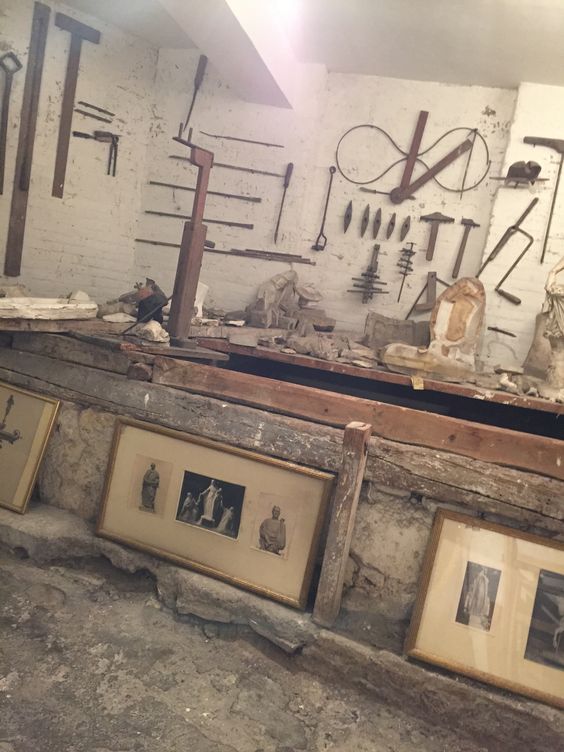
There were so many points where I felt uncertain! I always come back to the small details of a life such as the sculpting tools she would have used and the meals she likely ate. Small sensory details often can set my direction.

Visit Jeannine's STONE MIRRORS Pinterest board
for more details of Edmonia's life and work.
Please share a favorite passage from Stone Mirrors and tell us why it’s meaningful to you.
The past changes every time we look back.
… History is not only caught
in vaults or glass cases, but is what’s shoved aside
or deliberately left out: The letter left within the pages
of a book, what was whispered over cake or soup.
This sums up why I write, looking for the common moments that can reveal what’s crucial.
 |
| Jeannine (L) with her grandmere and sister. |
I write about people from the past because biographies and historical fiction was my favorite reading as a girl. I didn’t make much distinction between fact and fiction, and found alternate homes for myself with Louisa May Alcott’s March family, Harriet the Spy, Joan of Arc, Virginia Dare, and Abigail Adams.
What’s coming up next for you?
I just finished a novel for middle readers with a bit of magic in it.
—So tantalizing!
If you had all the world’s children in one room, what would you tell them?
I’d go with most anything that Mr. Rogers has said.
 |
Read more Fred Rogers quotes at Goodreads.
|
 Finally, what have you chosen as this month’s ditty challenge?
Like most of us, Edmonia Lewis tries to avoid painful memories, but she also makes an art of memorializing people in statues. As I thought about the conflicting forces of memory in her life, it seemed memory had a life of its own. I personified Memory.
Here’s an example from Stone Mirrors:
She pulls away,
skids through a puddle, meaning to escape
Memory, who creeps through the dark,
but pounces in broad daylight, too.
… Memory can find her anywhere.
So here’s your challenge! Decide on an important feeling for a character, then let that be external. Maybe your character will have a conversation with personified feeling such as Joy, Fear, Anger, or Gratitude. Or maybe you will write about the personified feeling in some other way. Even if the personification drops out in a later draft, I bet you’ll have clarified the feeling!
How intriguing!
Please keep in mind that your poem can take any form, including lyrical prose. But if you do go with prose, please limit your passage to fewer than 200 words.
Won't you join me in thanking Jeannine Atkins for this wonderful interview?
And while you're at it, thank her for offering a personalized copy of Stone Mirrors: The Sculpture and Silence of Edmonia Lewis to one lucky DMC participant chosen randomly at the end of the month—HURRAY!
HOW TO PARTICIPATE:
Post a poem that uses personified feeling on our February 2017 padlet. Stop by any time during the month to add your work or to check out what others are contributing.
By posting on the padlet, you are granting me permission to share your poem on Today's Little Ditty. Some poems will be featured as daily ditties, though authors may not be given advanced notice. Subscribe to the blog if you'd like to keep tabs. You can do that in the sidebar to the right where it says "Follow TLD by Email." As always, all of the poems will be included in a wrap-up celebration on the last Friday of the month—February 24th for our current challenge.
TEACHERS, it's great when students get involved! Ditty of the Month Club challenges are wonderful opportunities to learn about working poets and authors while having fun with poetry prompts. Thank you for spreading the word! For children under 13, please read my COPPA compliance statement in the sidebar to the right.
FIRST-TIMERS (those who have never contributed to a ditty challenge before), in addition to posting your work on the padlet, please send your name and email address to TodaysLittleDitty (at) gmail (dot) com. That way I'll be able to contact you for possible inclusion in future Best of Today's Little Ditty anthologies.
BLOGGERS, thank you for publishing your poems on your own blogs– I love that! Please also remember to include your poem (or a direct link to your post) on the padlet in order to be included in the wrap-up celebration and end-of-month giveaway.
Now sharpen your chisels and pencils, folks, it's time to create!
* * * * * * * * * * * * * * * * * * * * * * * * * *

Vezenimost
Rosi Hollinbeck
Jan Godown Annino
Maria Marshall
and Carol Varsalona
Congratulations to all!


