Tuesday, April 9, 2019

Classroom Connections with Susannah Buhrman-Deever


TODAY'S READ

Predator and Prey: 
A Conversation in Verse

Susannah Buhrman-Deever, Author
Bert Kitchen, Illustrator

Candlewick Studio (April 9, 2019)
ISBN: 978-0763695330

For ages 7-10 (grades 2-5)

Purchase at Amazon.com
Purchase at Barnes & Noble
Purchase via Indiebound.org


SYNOPSIS

The battle for survival between predator and prey is sometimes a fight, sometimes a dance, and sometimes involves spying, lying, or even telling the truth to get ahead. Biologist and debut author Susannah Buhrman-Deever explores these clashes in poems and prose explanations that offer both sides of the story. With beautiful, realistic illustrations that are charged with drama, Bert Kitchen captures the breathtaking moments when predator meets prey.


A LOOK INSIDE

Click on image to enlarge.

PREDATOR AND PREY: A CONVERSATION IN VERSE. Text copyright © 2019 by Susannah Buhrman-Deever.
Illustrations copyright © 2019 by Bert Kitchen. Reproduced by permission of Candlewick Press, Somerville, MA.


ABOUT THE AUTHOR

Susannah Buhrman-Deever is the author of Predator and Prey: A Conversation in Verse (Candlewick Studio). She is a former field biologist with a PhD in animal behavior, which means she has spent a lot of time thinking about why animals do what they do. Now she shares her love of nature with young and curious readers. She lives with her husband and sons near Rochester, NY.


CLASSROOM CONNECTIONS

Why is bringing poetry into the classroom important?

Poetry has been a part of my life since my childhood (Shel Silverstein’s books were some of my first loves), but my answer to this question also comes from my background as a biologist. I believe writing poetry is a practice that develops skills essential not just to the language arts, but science as well. 


Observation is key to both. All scientific inquiry begins with examining the world around us. We can’t know what questions to ask without first looking closely. Close observation is also critical for writing poetry. To really capture a subject, a poet has to use all of his/her senses to go deeper than a surface description.

Both also involve critical thinking and revision. When we design scientific research, we ask ourselves: What is most important to answering my question? Am I approaching my question in the right way? What else may I have missed? When we write and revise poems, we ask similar questions: What is most important for me to capture my subject? Does this line/word work? For both scientific work and poetry writing, we need to go back, ask questions, and try, try again.


But perhaps most of all, I think reading and writing poetry in the classroom gives students breathing space. Space to practice slowing down, really look at the world around them, and think deeply.

How might your book be incorporated into an educational curriculum?

This book came about from my interest in writing about the sometimes surprising interactions between predators and prey in nature, especially how animals can use a variety of tactics (including eavesdropping, lying, and even honesty) in their fight for survival.

The interactions highlighted in the book can be used as a springboard to investigations about relationships between animals in nature, and how they have different adaptations or behaviors that help them survive.

Can you suggest a specific classroom exercise related to your book?

Investigating Relationships in Nature Through Conversation Poems

The poems in this book examine encounters between predators and prey. After reading and discussing the book, ask your students to investigate further about relationships between different living things in the environment.

Have each student choose two living things that interact with each another. They could be predator and prey (like in this book), or have a partnership (like a plant-pollinator relationship).


Then ask students to use library books and/or websites to research their subjects, especially noting what each looks like, and what each does, and why. After they’ve completed their research, they can write either a poem for two voices or a pair of poems (one for each “voice”) using the information they’ve learned, and share their poems with the class. 


For extra credit: Students can create their own “nonfiction note” to complement their poem(s), further explaining the relationship between their subjects.

What is a simple, practical tip for teachers when it comes to incorporating poetry in the classroom?

Share a poem every day! It's a great way to initially engage students before they start science investigations.


I’ve been thrilled to see so many science- and nature-based poetry collections come out in recent years, which can be used to kick off any science lesson. The Poetry Friday Anthology for Science (compiled by Sylvia Vardell and Janet Wong) is a great place to start.

Can you recount a specific instance of when poetry impacted a student or group of students in a positive way?

A number of years ago, I was going to speak to a sixth grade class about animal behavior. The students had just come back from lunch, and had a substitute teacher that day to boot. Needless to say, they were not initially very focused on why I was there or what I had to say.

I asked the students for volunteers, and together we read an early draft of “Spies”, a poem for two voices that’s included in Predator and Prey. The whole class perked up, and were engaged for the rest of my presentation.

That experience really taught me how sharing poetry, and the sheer delight students can have in language and rhythm, can bring a class together and engage them in lessons. It’s so much easier to instruct if you are also entertaining.


CONNECT WITH SUSANNAH BUHRMAN-DEEVER

Website: buhrmandeever.com

Look for If You Take Away the Otter (Candlewick), a nonfiction picture book about sea otters and kelp forests, illustrated by Matthew Trueman, in 2020.


Many thanks to Susannah for participating in our Classroom Connections series for National Poetry Month, and for offering a copy of Predator and Prey: A Conversation in Verse to one randomly selected TLD reader!

To enter, leave a comment below or send an email with the subject "Predator and Prey Giveaway" to TodaysLittleDitty (at) gmail (dot) com by Tuesday, April 30, 2019. Winners will be announced on Thursday, May 2nd, so be sure to check back to see if you've won!


 * * * * * * * * * * * * * * * * * * * *

Check out the other Classroom Connections posts and giveaways on offer this month by clicking the names below!


Digital art © 2018 by Miranda Barnes,
based on a line from "Ghazal" by Tracy K. Smith.


TO FOLLOW:

The best way to keep up with the Classroom Connections series is by subscribing to Today's Little Ditty via email, which you can do in the sidebar. I will also be announcing the posts on social media. Like me on Facebook and/or follow me on Twitter (also in the sidebar) to stay informed that way. Catch up with Classroom Connections posts you may have missed by clicking on the "It's time to INSPIRE" icon in the sidebar, or by visiting my "Poetry in the Classroom" board on Pinterest.

Monday, April 8, 2019

Classroom Connections with Debbie Levy


TODAY'S READ

This Promise of Change: One Girl's Story in the Fight for School Equality

Jo Ann Allen Boyce and Debbie Levy, Authors

Bloomsbury Children's Books (January 8, 2019)
ISBN: 978-1681198521

For age 10 to adult

Purchase at Amazon.com
Purchase at Barnes & Noble
Purchase via Indiebound.org


SYNOPSIS

In 1954 the U.S. Supreme Court ruled that racially segregated schools violated the U.S. Constitution. This decision, Brown v. Board of Education, was a big and historic deal, but Supreme Court rulings do not enforce themselves. If Brown‘s promise of change was to become reality, people had to take action. And so in 1956, in the small town of Clinton, Tennessee, twelve African American high school students stepped up. Opposition in the white population soon turned into anger and violence, and even the Clinton 12 themselves wondered if the easier thing to do would be to go back to their old school. Jo Ann—clear-eyed, practical, and tolerant—found herself called on as a spokesperson for the group. But what about just being a regular teen? This is the story of her four months thrust into the national spotlight and as a trailblazer in history. Most people haven’t heard of the Clinton 12, but what they did in 1956 (a year before the Little Rock 9) was front-page news all over the nation. My co-author, Jo Ann Allen Boyce, was one of the Clinton 12, and we have worked together to tell her story. Like my book The Year of Goodbyes, this is nonfiction in verse, with primary archival materials and a good deal of backmatter features.


A PEEK INSIDE

To introduce the excerpt: Except for the introduction and for the back matter, This Promise of Change is written in verse—free verse and also some structured forms (such as sonnets, odes, ballads, pantoums). It took a while for my co-author and me to figure out how we might best tell the story. But I kept coming back to Jo Ann’s voice, and I felt inspired by her jazz background to suggest we do something that reflected her musicality.

But it wasn’t only that poetry fit Jo Ann; poetry also fit the story. I really like the compactness of poetry and I think poetry is great at conveying emotion and this is an emotional story. For example, there is a white pastor in Clinton, Rev. Paul Turner, who, after months of standing on the sidelines, risks his life to accompany Jo Ann and the other African American students to school. He’s beaten by a mob of white adults to within an inch of his life right outside the school. Jo Ann is driven home by police. Here’s that ride home in “Notes To Myself in the Squad Car.” Read it aloud!

Click on images to enlarge.

Copyright © 2019 by Jo Ann Allen Boyce and Debbie Levy, from THIS PROMISE OF CHANGE:
ONE GIRL’S STORY IN THE FIGHT FOR SCHOOL EQUALITY (Bloomsbury Children’s Books)


ABOUT THE AUTHOR


Debbie Levy is the author of more than 25 books of nonfiction, fiction, and poetry for young people, including New York Times best-selling I Dissent: Ruth Bader Ginsburg Makes Her Mark, winner of the Sydney Taylor Book Award and National Jewish Book Award. Her latest book is This Promise of Change: One Girl’s Story in the Fight for School Equality (with Jo Ann Allen Boyce; nonfiction-in-verse for middle grade/YA), Debbie is also the author of Soldier Song: A True Story of the Civil War, a Publishers Weekly, Huffington Post, and Bank Street College Best Book; We Shall Overcome: The Story of a Song, a Jane Addams Award Honor Book and Bank Street College Best Book; and The Year of Goodbyes, a Sydney Taylor Notable Book and Kirkus Reviews Best Book. A former lawyer and newspaper editor, Debbie lives in Maryland with her husband. They have two grown sons.


CLASSROOM CONNECTIONS

Why is bringing poetry into the classroom important?

Poetry provides an accessible way to bring hard things—difficult emotions, events, worries—to the surface, both in reading and in writing. I think narratives written poetry can be a great way to lead students into challenging subjects because poetry is open and airy, not dense and intimidating, and because a reader can sit down and tear through a book in one sitting, or read and digest it one poem at a time.

At the same time, it’s not only about hard things; poetry also provides a way to notice, really notice, everyday life and to infuse it with brightness, thoughtfulness, and humor (again, both in reading and in writing). Finally, I love the economy of poetic language and I think it’s important, as we guide students’ writing, to show that more isn’t necessarily better; that making every word count, as we must in poetry, is a practice that will make prose stronger, too; and that word choice isn’t only important, it’s fun!

Can you suggest a specific classroom exercise related to your book?

Imagine there’s one more student in the group of twelve, the Clinton 12 becomes the Clinton 13—and you are that thirteenth student. Write your own poem set in one of the pivotal moments in the story—either the night before the students first walk down the Hill to enter Clinton High School (Chapter 22), or that first walk itself (Chapter 23), or when white Clinton erupts during that first week of school, or after Thanksgiving when things get even worse. Use any of the poetic forms used in the book (see page 277 for the list).

How might your book be incorporated into an educational curriculum?

First, I’d suggest empathy exercises, in which students are putting themselves in the shoes of the Clinton 12. The exercise provided above is a start. Add others in which we are asking students to write poems and prose from the point of view of an imagined thirteenth student (or themselves) about how home life and family supported, or disappointed, that fictional student during the crisis; how the relationship with a friend or friends affected this fictional student; whether this student would prefer not to be part of the group of students desegregating Clinton High School.

Second, in a curriculum that connects the Civil Rights movement to the question of whose stories get told, discuss with the students why the desegregation crisis in Clinton 12 has been mostly lost to history: In Clinton, there was more nuance in the reaction and behaviors of the white leaders, both at the local and state levels, than in Little Rock, for example—so it’s a more complex story to tell. And in Little Rock, as later in the case of Ruby Bridges in New Orleans, there were iconic images—the famous photo of Elizabeth Eckford in Little Rock, the Norman Rockwell painting of Ruby Bridges—that became lodged in the public consciousness, something Clinton lacked.

What is a simple, practical tip for teachers when it comes to incorporating poetry in the classroom?

I’m a big fan of the Poetry Friday Anthology series of books, edited by Sylvia Vardell and Janet Wong, and not just because I have some poems in them! They provide weekly poems and related suggestions for helping students enjoy and learn from them.


CONNECT WITH DEBBIE LEVY

Website: www.debbielevybooks.com
Facebook: https://www.facebook.com/debbie.levy.79
Twitter: @debbielevybooks
Instagram: debbielevybooks

Look for three more books from Debbie Levy coming out later this year:

Becoming RBG: Ruth Bader Ginsburg’s Journey to Justice (middle grade biography in graphic novel format) (Simon & Schuster), The Key from Spain: Flory Jagoda and Her Music (picture book biography) (Kar-Ben) and a fiction picture book titled Yiddish Saves the Day! (Apples & Honey Press).


Many thanks to Debbie for participating in our Classroom Connections series for National Poetry Month, and for offering a copy of This Promise of Change to one randomly selected TLD reader!

To enter, leave a comment below or send an email with the subject "This Promise Giveaway" to TodaysLittleDitty (at) gmail (dot) com by Tuesday, April 30, 2019. Winners will be announced on Thursday, May 2nd, so be sure to check back to see if you've won!


 * * * * * * * * * * * * * * * * * * * *

Check out the other Classroom Connections posts and giveaways on offer this month by clicking the names below!


Digital art © 2018 by Miranda Barnes,
based on a line from "Ghazal" by Tracy K. Smith.


TO FOLLOW:

The best way to keep up with the Classroom Connections series is by subscribing to Today's Little Ditty via email, which you can do in the sidebar. I will also be announcing the posts on social media. Like me on Facebook and/or follow me on Twitter (also in the sidebar) to stay informed that way. Catch up with Classroom Connections posts you may have missed by clicking on the "It's time to INSPIRE" icon in the sidebar, or by visiting my "Poetry in the Classroom" board on Pinterest.

Friday, April 5, 2019

Classroom Connections with Janet Wong


TODAY'S READ

A Suitcase of Seaweed & MORE

Janet Wong, Author

YUZU, an imprint of Pomelo Books
(February 28, 2019)

ISBN: 978-1937057336

For ages 10 and up

Purchase at Amazon.com


SYNOPSIS

A Suitcase of Seaweed was published in 1996 by Margaret K. McElderry Books (Simon and Schuster) as thirty-six poems plus three prose pieces. IA Suitcase of Seaweed & MORE, you’ll find 50 new pages containing snippets of story about the inspiration behind the poems, extensions of the themes, and prompts to get readers thinking about their own identities. Wong’s “Advice for Writers” will inspire them to write their own books, too!


A PEEK INSIDE

Click on images to enlarge.


ABOUT THE AUTHOR

Read Janet Wong’s spotlight interview
on Today's Little Ditty HERE.
Janet Wong is a graduate of Yale Law School and a former lawyer who switched careers to become a children’s author. Her dramatic career change has been featured on The Oprah Winfrey Show, CNN’s Paula Zahn Show, and Radical Sabbatical. She is the author of more than 30 books for children and teens on a wide variety of subjects, including writing and revision (You Have to Write), diversity and community (Apple Pie 4th of July), peer pressure (Me and Rolly Maloo), chess (Alex and the Wednesday Chess Club), and yoga (Twist: Yoga Poems). A frequent featured speaker at literacy conferences, Wong has served as a member of several national committees, including the NCTE Poetry Committee and the ILA Notable Books for a Global Society committee. Her current focus is encouraging children to publish their own writing using affordable new technologies.


CLASSROOM CONNECTIONS

Why is bringing poetry into the classroom important?

Why is it important to have snacks? They're a quick pick-me-up for instant energy—and they make us happy. Poems are the same way!

How might your book be incorporated into an educational curriculum?

The prose pieces and writing prompts that go with each poem make it easy, I hope, to share a poem—and use it in a lesson—anytime a moment presents itself.

Can you suggest a specific classroom exercise related to your book?

For each of the poems in the book, including the two shared above, you'll find prompts to get students thinking and talking—or even writing. (Click on the images for easier reading.)

What is a simple, practical tip for teachers when it comes to incorporating poetry in the classroom?

Don’t wait for pre-planned time slots to share poetry. If you’re teaching a subject and you suddenly remember that there’s a poem for that, jump up, grab the poem, and read it aloud. You can even use a poem for an impromptu 30-second indoor recess!

Can you recount a specific instance of when poetry impacted a student or group of students in a positive way?

When I’m at schools, very often a kid will come up to me and give me a poem. Just shove it into my hand or put it in my suitcase without saying much (if anything). Usually these are very serious poems about the death of a family member or feeling alone. I'll scribble a quick note on the poem and return it to the student as a way to say, “Yes, you are right: poems are here for all your thoughts and feelings. Keep it up!” I think we’d make progress in our national mental health if every student wrote a poem each day that they immediately tore to shreds—a poem of release. Knowing that we’d have to tear it up would make us feel safe to say the things we really need to say.


CONNECT WITH JANET WONG

Website: https://www.janetwong.com
Twitter: @janetwongauthor


Many thanks to Janet for participating in our Classroom Connections series for National Poetry Month, and for providing me with TWO copies of A Suitcase of Seaweed & MORE for randomly selected TLD readers!

To enter, leave a comment below or send an email with the subject "Seaweed Giveaway" to TodaysLittleDitty (at) gmail (dot) com by Tuesday, April 30, 2019. Winners will be announced on Thursday, May 2nd, so be sure to check back to see if you've won!


 * * * * * * * * * * * * * * * * * * * *

Check out the other Classroom Connections posts and giveaways on offer this month by clicking the names below!


Digital art © 2018 by Miranda Barnes,
based on a line from "Ghazal" by Tracy K. Smith.


TO FOLLOW:

The best way to keep up with the Classroom Connections series is by subscribing to Today's Little Ditty via email, which you can do in the sidebar. I will also be announcing the posts on social media. Like me on Facebook and/or follow me on Twitter (also in the sidebar) to stay informed that way. Catch up with Classroom Connections posts you may have missed by clicking on the "It's time to INSPIRE" icon in the sidebar, or by visiting my "Poetry in the Classroom" board on Pinterest.


Jama Rattigan has rounded up a rousing collection of National Poetry Month activities, projects, and Kidlitosphere celebrations at Jama's Alphabet Soup.


Please join Karen Edmisten for this week's Poetry Friday roundup.

Thursday, April 4, 2019

Classroom Connections with Skila Brown


TODAY'S READ

Clackety Track: 
Poems About Trains

Skila Brown, Author
Jamey Christoph, Illustrator

Candlewick Press (March 12, 2019)
ISBN: 978-0763690472

For grades 1-4

Purchase at Amazon.com
Purchase at Barnes & Noble
Purchase via Indiebound.org


SYNOPSIS

Queue up for a whistle-stop tour of trains of all kinds, narrated in lively verse and featuring dynamic retro artwork.

Rows of grooves, cables, and bars.
Graffiti rockin’ out the cars.
A badge of rust. A proud oil stain.
There’s nothin’ plain about a train.


Trains of all shapes and sizes are coming down the track — bullet train, sleeper train, underground train, zoo train, and more. All aboard! Skila Brown’s first-class poems, as varied as the trains themselves, reflect the excitement of train travel, while Jamey Christoph’s vintage-style illustrations provide a wealth of authentic detail to pore over.


A PEEK INSIDE

Text copyright © 2019 by Skila Brown. Illustrations copyright © 2019 by Jamey Christoph.
 From CLACKETY TRACK: POEMS ABOUT TRAINS (Candlewick Press).


ABOUT THE AUTHOR


Skila Brown's first job was working on a train. She sold hot dogs through the window of a shiny red caboose in the coal-filled hills of eastern Kentucky. Now she writes books for readers of all ages from her home in Indiana.


CLASSROOM CONNECTIONS

Why is bringing poetry into the classroom important?

Poetry is concise and specific; it doesn't waste words. Listening to it and creating it forces us to sharpen our communication skills and better express what we are trying to say.

How might your book be incorporated into an educational curriculum?

April is National Poetry month! Always a good time to find ways to bring poetry into the classroom. But outside of language arts, Clackety Track has social studies tie-ins (time zones were created because of trains!) and science explorations (how does steam power an engine?)

Can you suggest a specific classroom exercise related to your book?

The educator's guide for Clackety Track: Poems About Trains contains classroom activities. View (and download) HERE.

What is a simple, practical tip for teachers when it comes to incorporating poetry in the classroom?

Poems are great tools for transition times. Finished up with math for the day and ready to have students line up for recess? Why not take thirty seconds to read aloud an appropriate poem. Keeping a good poetry anthology on your desk can help serve as a quick way to settle down students and get them ready for the next part of the day.

Can you recount a specific instance of when poetry impacted a student or group of students in a positive way?

I'm constantly hearing from ENL teachers that for kids who are struggling to learn a new language, a novel in verse or a book of poems is such a good choice for reading. The white space and low word count per page means they can turn the page more frequently. It brings along the feeling of success and thus keeps them engaged.


CONNECT WITH SKILA BROWN

Website: www.skilabrown.com


Many thanks to Skila for participating in our Classroom Connections series for National Poetry Month, and for offering a copy of Clackety Track: Poems About Trains to one randomly selected TLD reader! (US addresses only.)

To enter, leave a comment below or send an email with the subject "Clackety Track Giveaway" to TodaysLittleDitty (at) gmail (dot) com by Tuesday, April 30, 2019. Winners will be announced on Thursday, May 2nd, so be sure to check back to see if you've won!


 * * * * * * * * * * * * * * * * * * * *

Check out the other Classroom Connections posts and giveaways on offer this month by clicking the names below!


Digital art © 2018 by Miranda Barnes,
based on a line from "Ghazal" by Tracy K. Smith.


TO FOLLOW:

The best way to keep up with the Classroom Connections series is by subscribing to Today's Little Ditty via email, which you can do in the sidebar. I will also be announcing the posts on social media. Like me on Facebook and/or follow me on Twitter (also in the sidebar) to stay informed that way. Catch up with Classroom Connections posts you may have missed by clicking on the "It's time to INSPIRE" icon in the sidebar, or by visiting my "Poetry in the Classroom" board on Pinterest.

Wednesday, April 3, 2019

Classroom Connections with Carole Boston Weatherford


TODAY'S READ

The Roots of Rap:
16 Bars on the 4 Pillars of Hip-Hop

Carole Boston Weatherford, Author
Frank Morrison, Illustrator

little bee books (January 8, 2019)
ISBN: 978-1499804119 

For all ages (K-12)

Purchase at Amazon.com
Purchase at Barnes & Noble
Purchase via Indiebound.org


SYNOPSIS

The roots of rap and the history of hip-hop have origins that precede DJ Kool Herc and Grandmaster Flash. Kids will learn about how it evolved from folktales, spirituals, and poetry, to the showmanship of James Brown, to the culture of graffiti art and breakdancing that developed around the art form and gave birth to the musical artists we know today. Lyrical rhythm combines with flowing, vibrant illustrations to illustrate how hip-hop is a language spoken the whole world ’round. The book includes a glossary and features a foreword by Swizz Beatz, a Grammy Award-winning American hip-hop rapper, DJ, and record producer.


A PEEK INSIDE

Text copyright © 2019 by Carole Boston Weatherford. Illustrations copyright © 2019 by Frank Morrison.
From THE ROOTS OF RAP: 16 BARS ON THE 4 PILLARS OF HIP-HOP (little bee books).


"Folktales, street rhymes, spirituals—rooted in spoken word.  
Props to poets Hughes and Dunbar; published. Ain't you heard?"

© 2019 Carole Boston Weatherford, all rights reserved.


ABOUT THE AUTHOR

Read Carole Boston Weatherford’s spotlight
interview on Today's Little Ditty HERE.


Carole Boston Weatherford has authored 55 books, including three Caldecott Honor and two NAACP Image Award winners and five titles that have won Coretta Scott King Awards or Honors. Her best-known books include: Moses: When Harriet Tubman Led Her People to Freedom, Before John Was a Jazz Giant: A Song of John Coltrane, Freedom in Congo Square, Becoming Billie Holiday and Voice of Freedom: Fannie Lou Hamer. Her latest picture book is The Roots of Rap: 16 Bars on the 4 Pillars of Hip-Hop. Carole is a professor at Fayetteville State University in North Carolina.


CLASSROOM CONNECTIONS

Why is bringing poetry into the classroom important?

Poetry tickles the tongue, trains the ear to listen and appeals to the emotional intelligence. Poetry also has white space, which struggling readers may find more inviting than prose.

How might your book be incorporated into an educational curriculum?

The Roots of Rap can be used during the study of African American poetry and musical and oral traditions. Students can compare rap lyrics to Paul Laurence Dunbar's  dialect poems and Langston Hughes' blues poems.

Much of my work is inspired by oral traditions and African rhythms and invites choral reading or call-and-response. As such, The Roots of Rap could be paired with such titles as Freedom in Congo Square, Sugar Hill: Harlem's Historic Neighborhood, The Sound that Jazz Makes, Before John Was a Jazz Giant, Jazz Baby, or Be a King: Dr. Martin Luther King, Jr.'s Dream and You. 

Can you suggest a specific classroom exercise related to your book?

The best rap lyrics not only rhyme but utilize multiple literary devices. Here is a handout developed by Paul Carl explaining literary elements and citing examples from rap lyrics. The accompanying exercise asks students to identify those elements in excerpts from rap songs.

What is a simple, practical tip for teachers when it comes to incorporating poetry in the classroom?

Share one poem a week with your students. Read it aloud every day. Do not require the students to memorize or analyze the poem, just to listen and connect with it in their own way.

Can you recount a specific instance of when poetry impacted a student or group of students in a positive way?

I recently shared The Roots of Rap at a public library. I also mentioned having composed my first poem in first grade. A few weeks later, I heard that a first grader who was in the audience has been writing a poem a day ever since.


CONNECT WITH CAROLE BOSTON WEATHERFORD

Website: http://cbweatherford.com
Twitter: @poetweatherford
Instagram: @caroleweatherford


Many thanks to Carole for participating in our Classroom Connections series for National Poetry Month, and to little bee books for providing me with a copy of The Roots of Rap for one randomly selected TLD reader!

To enter, leave a comment below or send an email with the subject "Roots of Rap Giveaway" to TodaysLittleDitty (at) gmail (dot) com by Tuesday, April 30, 2019. Winners will be announced on Thursday, May 2nd, so be sure to check back to see if you've won!


* * * * * * * * * * * * * * * * * * * *

Check out the other Classroom Connections posts and giveaways on offer this month by clicking the names below!

  • Eric Ode (Otters, Snails and Tadpole Tails: Poems from the Wetlands)
  • Kip Wilson (White Rose) 

Digital art © 2018 by Miranda Barnes,
based on a line from "Ghazal" by Tracy K. Smith.


TO FOLLOW:

The best way to keep up with the Classroom Connections series is by subscribing to Today's Little Ditty via email, which you can do in the sidebar. I will also be announcing the posts on social media. Like me on Facebook and/or follow me on Twitter (also in the sidebar) to stay informed that way. Catch up with Classroom Connections posts you may have missed by clicking on the "It's time to INSPIRE" icon in the sidebar, or by visiting my "Poetry in the Classroom" board on Pinterest.

Tuesday, April 2, 2019

Classroom Connections with Kip Wilson


TODAY'S READ

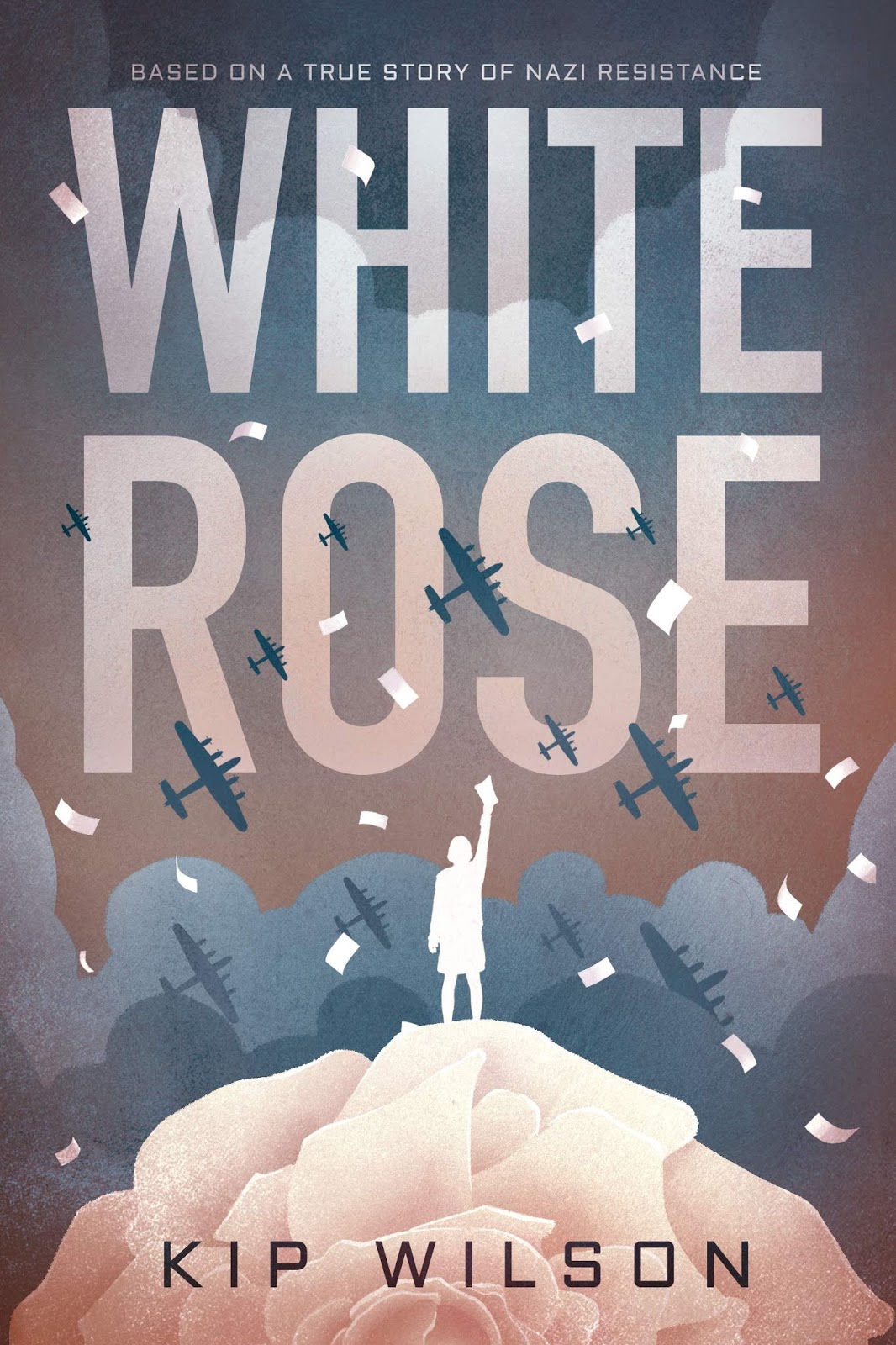
White Rose

Kip Wilson, Author

Versify (April 2, 2019)
ISBN: 978-1328594433

For ages 12 and up

Purchase at Amazon.com
Purchase at Barnes & Noble
Purchase via Indiebound.org


SYNOPSIS

Disillusioned by the propaganda of Nazi Germany, Sophie Scholl, her brother, and his fellow soldiers formed the White Rose, a group that wrote and distributed anonymous letters criticizing the Nazi regime and calling for action from their fellow German citizens. The following year, Sophie and her brother were arrested for treason and interrogated for information about their collaborators. This debut novel recounts the lives of Sophie and her friends and highlights their brave stand against fascism in Nazi Germany.


A PEEK INSIDE

SELFLESSNESS
Letter to Fritz, June 1940

Dear Fritz,

People shouldn’t be
    ambivalent
about the world around
them simply because
everyone else
is ambivalent.

People who
    refuse
to open their eyes
are more than ambivalent—
they are guilty.

How can we expect
    justice
in this world
if we’re not prepared to
sacrifice ourselves
for what’s right?


Copyright © 2019 by Kip Wilson, used by permission of Houghton Mifflin Harcourt.


ABOUT THE AUTHOR


Kip Wilson is the Poetry Editor of the Young Adult Review Network and holds a Ph.D. in German Literature. In 2017, she won the PEN/New England Susan P. Bloom Discovery Award, and her work has appeared in several children’s literary magazines.


CLASSROOM CONNECTIONS

Why is bringing poetry into the classroom important?

Poetry is a form of writing and reading, but it’s also a form of art. It’s a great way to get kids to notice the world around them and to say more with less. Because poetry is generally less wordy, it’s also a great way to engage less enthusiastic readers. They’ll find they can make it through an entire novel in verse with much more ease than a comparable prose novel, giving them a sense of accomplishment. Also, with so many easily definable forms of poetry to try out, everyone can write something.

How might your book be incorporated into an educational curriculum?

Because White Rose is a historical novel based on true events as well as a novel in verse, it fits in well both to the ELA and Social Studies curricula. My publisher created a fantastic educator guide (available at http://www.kipwilsonwrites.com/wp-content/uploads/2019/02/WhiteRose.NotBeSilent.pdf), which can be used to teach White Rose alongside We Will Not Be Silent, an award-winning work of nonfiction about the group. Beyond all that though, the message of the White Rose to speak up for marginalized groups is an especially important one today for teens getting involved in social justice.

Can you suggest a specific classroom exercise related to your book?

I loved Nikki Grimes’ book One Last Word, in which she uses lines from poems from the Harlem Renaissance to create new, timely poems using the Golden Shovel poetic form. In a Golden Shovel, each line in the new poem ends with a word from the original poem, so that, for instance, each of the words in Jean Toomer’s line, “Thunder blossoms gorgeously above our heads,” from “Storm Ending” appear as the last words in each line of Nikki Grimes’ poem, “Truth.”

Students should use the first line from the above poem from White Rose to create a Golden Shovel poem of your own, so that each line ends with the following words:

people
shouldn’t
be
ambivalent
about
the
world
around
them
simply
because
everyone
else
is
ambivalent

What is a simple, practical tip for teachers when it comes to incorporating poetry in the classroom?

I love “The Slowdown” podcast with Traci K. Smith. She delivers a bit of commentary along with a poem (each weekday by a different author) that forces me to take five minutes out of my day to slow down and listen and reflect. I love that it arrives in my inbox in the morning right as I’m getting ready for my day. The content of this particular podcast is aimed at adults, but the idea would transfer well into the classroom: once everyone’s settled at their desks to begin the day, give them a little commentary and then read them a poem.

Can you recount a specific instance of when poetry impacted a student or group of students in a positive way?

I have been loving the reactions around the country to students reading The Poet X by Elizabeth Acevedo. This award-winning novel in verse is revolutionary in so many ways. I’ve seen Elizabeth perform her poetry, so I can attest to the way her words energized the entire audience, but more than that, the way she was able to get her own experience on the page for girls like her to be able to see themselves is simply incredible. What a way to empower students! 


CONNECT WITH KIP WILSON

Website: http://www.kipwilsonwrites.com/
Twitter: https://twitter.com/kiperoo
Instagram: https://www.instagram.com/kipwilsonwrites


Please help me thank Kip for participating in our Classroom Connections series for National Poetry Month by leaving a comment below.

* * * * * * * * * * * * * * * * * * * *

Check out the other Classroom Connections posts and giveaways on offer this month by clicking the names below!

  • Eric Ode (Otters, Snails and Tadpole Tails: Poems from the Wetlands)

Digital art © 2018 by Miranda Barnes,
based on a line from "Ghazal" by Tracy K. Smith.


TO FOLLOW:

The best way to keep up with the Classroom Connections series is by subscribing to Today's Little Ditty via email, which you can do in the sidebar. I will also be announcing the posts on social media. Like me on Facebook and/or follow me on Twitter (also in the sidebar) to stay informed that way. Catch up with Classroom Connections posts you may have missed by clicking on the "It's time to INSPIRE" icon in the sidebar, or by visiting my "Poetry in the Classroom" board on Pinterest.

Monday, April 1, 2019

Classroom Connections with Eric Ode


TODAY'S READ

Otters, Snails and Tadpole Tails: Poems from the Wetlands

Eric Ode, Author
Ruth Harper, Illustrator

Kane Miller Books (March 1, 2019)
ISBN: 978-1610677479

For all ages (K-12)

Purchase at Usborne Books & More
Purchase at Barnes & Noble
Purchase via Indiebound.org


SYNOPSIS

From raccoons to muskrats, frogs to heron, acclaimed singer/songwriter/poet Eric Ode offers readers of all ages a gentle, stunningly beautiful homage to all things wetland. Featuring New York Times bestselling illustrator Ruth Harper’s gorgeous artwork, Otters, Snails and Tadpole Tails is a picture book celebration of biodiversity, art, poetry and healthy ecosystem.


A PEEK INSIDE

Click on image to enlarge.

Text copyright © 2019 by Eric Ode. Illustrations copyright © 2019 by Ruth Harper.
From OTTERS, SNAILS AND TADPOLE TAILS: POEMS FROM THE WETLANDS (Kane Miller).


ABOUT THE AUTHOR

Eric Ode (pronounced Oh-dee) is a national award-winning children's singer/songwriter and a widely published author and poet. A former elementary teacher, Eric has been invited to share his music and poetry programs with schools and at community events throughout the United States, in Germany, Japan, and in Guam. Otters, Snails and Tadpole Tails is Ode’s fourth published poetry collection.


CLASSROOM CONNECTIONS

Why is bringing poetry into the classroom important?

Poetry gives students permission and freedom to play with and experiment with language – to discover how words and images can spark on our tongues and ignite our imaginations.

How might your book be incorporated into an educational curriculum?

This book offers so many opportunities for diving into the natural sciences. There’s a poem about a dragonfly that offers an opportunity to talk about metamorphosis. Another poem about a shrew and a bat opens the door to discussing habitat and diet. Of course the entire collection naturally leads into discussions on the importance of healthy wetlands for migratory birds, prevention of soil erosion, filtration of toxins, flood control...

Can you suggest a specific classroom exercise related to your book?

CLASSIFYING CRITTERS

Use selected poems from Otters, Snails and Tadpole Tails as an opportunity to group animals. This can be done little by little, sharing one or two poems each day.
  1. Create a large, empty chart with columns for each animal group. (See possible groups below)
  2. Read a poem or have a student read to the class.
  3. As a class, discuss characteristics of the animal.
  4. Decide into which group the animal belongs.
  5. Add that animal’s name to that group on the chart.
POSSIBLE GROUPS (Older Students)
  • Invertebrates, Amphibians, Reptiles, Birds, Mammals, and Fish
  • Animals that go through metamorphosis
  • Insects/Not Insects
POSSIBLE GROUPS (Younger Students)
  • Mammals/Not Mammals
  • Birds/Not Birds
  • Animals with legs/Animals without legs

What is a simple, practical tip for teachers when it comes to incorporating poetry in the classroom?

When the schedule allows, I love giving students an opportunity to discover analogous language, especially similes and metaphors. We use stations in a Lucy Calkins sort of way with items set out to pick up and hold and consider, and then we move into making connections. What does this look like? What does this remind you of? Watching students surprise themselves when they make a unique connection is always a treat!

Can you recount a specific instance of when poetry impacted a student or group of students in a positive way?

Because students are exposed to rhyme so early in life through song and Mother Goose rhymes and rhyming picture books, they naturally want to incorporate rhyme into their poetry. The problem, of course, is that using rhyme effectively is tough! And so often their insistence on using rhyme in poetry throws all of those other beautiful writing tools out the window – word choice, analogy, imagery, assonance, alliteration... I strongly encourage educators to put rhyme on the backburner while exposing students to poetry and discussing poetic tools.


CONNECT WITH ERIC ODE

Website: https://www.ericode.com/


Many thanks to Eric for participating in our Classroom Connections series for National Poetry Month, and for offering a copy of Otters, Snails and Tadpole Tails to one randomly selected TLD reader!

To enter, leave a comment below or send an email with the subject "Tadpole Tails Giveaway" to TodaysLittleDitty (at) gmail (dot) com by Tuesday, April 30, 2019. Winners will be announced on Thursday, May 2nd, so be sure to check back to see if you've won!


Digital art © 2018 by Miranda Barnes,
based on a line from "Ghazal" by Tracy K. Smith.


TO FOLLOW:

The best way to keep up with the Classroom Connections series is by subscribing to Today's Little Ditty via email, which you can do in the sidebar. I will also be announcing the posts on social media. Like me on Facebook and/or follow me on Twitter (also in the sidebar) to stay informed that way. Catch up with Classroom Connections posts you may have missed by clicking on the "It's time to INSPIRE" icon in the sidebar, or by visiting my "Poetry in the Classroom" board on Pinterest.