Thursday, January 15, 2015

Haiku Garden: Jone Rush MacCulloch


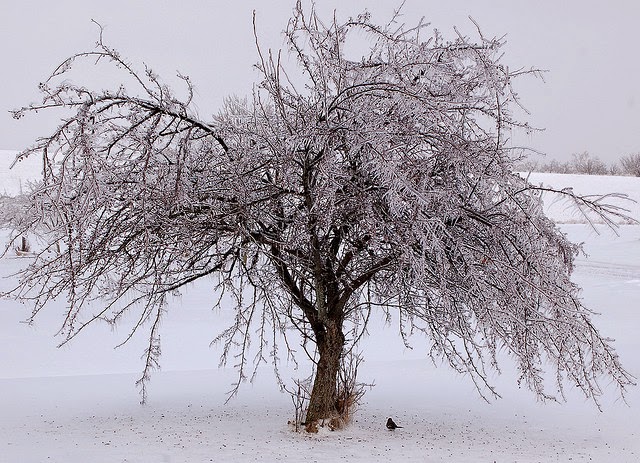
"Winter Strikes Back" by Bryce Mullet, Flickr Creative Commons

Jone Rush MacCulloch is no stranger to haiku.  For the last three years, she has participated in Shiki Kukai, a monthly haiku challenge that's now in its 19th year.  Each month, people from around the world write haiku based on two prompts– a Kigo, or seasonal word, and a free form word. The haiku are then anonymously distributed to the community for voting. Points are allotted by each member for 1st, 2nd and 3rd place entries, and the results are posted.  What a wonderful way to immerse yourself in the practice of writing this form!

Today I'm delighted to welcome Jone to the Haiku Garden. Given the difficult task of choosing amongst several of her beautiful and thought-provoking haiku, I decided upon this one, which was born from the February 2014 free form prompt: "longing."

For me, it was love at first sight...


                         between
                         snowfalls
                         the robin's song

                         © 2014 Jone Rush MacCulloch. All rights reserved.


"Winter Robin" by Bryce Mullet, Flickr Creative Commons


...and still I'm left longing for more.

Besides having the voice of a poet, Jone speaks with expertise as a library media specialist/teacher, and many sing her praises as Poetry Chair for the Cybils as well. (Find out more about the Children's and Young Adult Bloggers' Literary Awards HERE.) Did I mention that Jone also maintains three blogs? Her professional blog is called Check It Out: Life and Books in a K5 Library School Setting, her personal blog is Deo Writer, and Solace In Nature is her photography blog... oh yes, Jone is a talented photographer as well!

Thank you for taking a moment to share your talent
in the Haiku Garden, Jone.


In case you missed it, last week Joyce Sidman challenged us to write a "Deeper Wisdom" poem. You can find all the details HERE. So far I've featured poems from Katie Gast and Buffy Silverman, and today I must point you over to Reflections on the Teche, where Margaret Simon describes the deeper wisdom that she and her student poet, Matthew, achieved this week in the classroom.  I hope you'll consider sending me your poem. (Frankly, I can use all the wisdom I can get!)

You'll discover lots of wisdom in the poetry Irene Latham has selected to celebrate MLK Day. Those treasures and more can be found in today's Poetry Friday roundup at Live Your Poem.


DMC: "What Does the Snow Know?" by Buffy Silverman


WHAT DOES THE SNOW KNOW?

What does the snow know?
     To blanket the field with a whispery hush.  
     White’s the best backdrop for cardinal’s bright blush.
     Secrets are spilled in the tracks by the brush.

What does the snow know?
     Feeding a stream helps it ripple and rush.
     Beauty will fade and transform into slush.
     You’ve worn out your welcome when earth turns to mush.


© 2015 Buffy Silverman. All rights reserved.


Joyce Sidman has challenged us to write a "Deeper Wisdom" poem this month. What's a Deeper Wisdom poem, you ask? Click HERE for details.

Send your wise words to TodaysLittleDitty (at) gmail (dot) com, or use the contact form in the sidebar to the right. All contributions will be included in a wrap-up celebration on January 30, 2015, and one lucky participant will receive an autographed copy of Joyce's gorgeous new collection of children's poetry:


Tuesday, January 13, 2015

DMC: "What Do Hens Know?" by Katie Gast


WHAT DO HENS KNOW?

What do hens know? 
     Morning call is one cock’s crow.
     Their feed is scattered to and fro
     and all their eggs go to gateau. 

What do hens know?
     To find a spot far from the flow,
     to hide their nests so chicks can grow
     to brood, to cluck, to let them go.

© 2015 Katie Gast. All rights reserved.


Joyce Sidman has challenged us to write a "Deeper Wisdom" poem this month. What's a Deeper Wisdom poem, you ask? Click HERE for details.

Send your wise words to TodaysLittleDitty (at) gmail (dot) com, or use the contact form in the sidebar to the right. All contributions will be included in a wrap-up celebration on January 30, 2015, and one lucky participant will receive an autographed copy of Joyce's gorgeous new collection of children's poetry:


Thursday, January 8, 2015

Spotlight on Joyce Sidman + DMC Challenge


JOYCE SIDMAN

Joyce Sidman is the winner of the 2013 NCTE Award for Excellence in Children's Poetry, which is given every two years to a living American poet in recognition of his or her aggregate work. She is the author of many award-winning children’s poetry books, including the Newbery Honor-winning Dark Emperor and Other Poems of the Night, and two Caldecott Honor books: Song of the Water Boatman and Other Pond Poems (also a Lee Bennett Hopkins Poetry Award winner) and Red Sings from Treetops: A Year in Colors (which won the Claudia Lewis Poetry Award). Joyce teaches poetry writing to school children and participates in many national poetry events. She lives with her husband and dog near a large woodland in Wayzata, Minnesota.

Photo: Alan Shefland
With Joyce's recent book, Winter Bees & Other Poems of the Cold, the Newbery Honor award-winning partnership with printmaker (and fellow Minesotan) Rick Allen has brought us another critically acclaimed success. Winter Bees has been named a “Best Book of 2014” by School Library Journal, Kirkus Reviews, and the Chicago Public Library and has received five starred reviews! Educators should also be sure to check out this terrific readers' guide, created by Sylvia Vardell.

WINTER BEES & Other Poems of the Cold
Houghton Mifflin Harcourt, Nov 2014
ISBN: 978-0547906508
Click HERE to order.


Joyce has said that each of her books begins with a question.  In Winter Bees, she set out to discover how animals are able to survive the bitter cold of the long, northern winter.  From chickadees to honeybees, voles to moose, snakes to snow fleas, we learn of survival tactics as varied as the poetic forms Joyce uses to describe these resilient creatures.  Each of her twelve original poems is paired with fascinating sidebar information, and complemented by Rick Allen's exquisite hand-colored, digitally layered linocut illustrations.  Together, Joyce and Rick bring the beauty of this harsh winter landscape to life in evocative detail that jumps off the page. While the red fox on the cover does not have a poem of his own, the reader can follow his trail with every page turn. But fair warning: sometimes he's a trickster!

Photo: J. Sidman
Joyce didn't have any difficulty spotting him as he wandered past the bird feeder in her back yard.  Was he looking for an autograph? A share of the royalties?  Maybe he sniffed out the vole on page 21!


I'm honored to have Joyce join me as Today's Little Ditty's  first spotlight author of 2015. Please help me extend a warm welcome!  

As always, we'll start off the interview with a few favorites –

 
Vole Tunnels, photo: J. Sidman
Favorite thing to do in winter: 
     Find animal tracks in fresh snow.
Favorite sound: 
     First frogs calling in spring


Favorite music: 
     Traditional folk ballads

Favorite children’s book: 

     THE BAT-POET by Randall Jarrell


Favorite quote: 
"Like a piece of ice on a hot stove, 
 the poem must ride on its own melting."
                                                         ~Robert Frost

I’ve read that you didn’t set out to be a children’s poet—that it took some years to find “your voice.” What was that period of time like for you? And now that you’ve carved out your niche, what do you enjoy most about being a children’s author?
That period of time was tough. It involved a lot of risk-taking, a lot of failing, a lot of long, dark walks. But it was also a thrilling time, because I had nothing to lose and everything to gain. And eventually, I began to find my people – the writers I felt most comfortable among, which is what I love most about this work: the people of children’s literature—authors, illustrators, teachers, librarians.

Please describe your “writing zone”—when, where, and how you do your best work?
My writing zone is upstairs in my office. I head up there right after breakfast, with a mug of tea in my hand. I have a big, rounded stone that fits into the palm of my hand that I heft back and forth when I'm thinking or stuck. Which is a lot of the time!

You credit Alice Schertle’s ADVICE FOR A FROG as your inspiration for the poetry/ nonfiction hybrid that has become your trademark. Can you give us some insight into how you balance the research and creative aspects of your writing process?
I love research. It’s a process of uncovering mysteries. I would keep researching forever if I could. But eventually I realize that I've captured what I need to know and I'd better start writing before I lose the magic.

I'm sure I speak for many admirers of your work when I say that one of your gifts is your keen power of observation. Do you think that is something you were just born with or are there ways that writers can cultivate observational skills?
Thank you! It drives my family nuts sometimes, because I am always stopping to look at things, or remarking on them. I think I was born with a predilection for it, but I am certain it can be learned. All that is required is stillness and attention to your body: what you are seeing, feeling, smelling, hearing.

What inspired you to write WINTER BEES? Or what was the biggest challenge you faced in writing WINTER BEES?
Beaver dam, photo: J. Sidman
I live in Minnesota—that’s really the answer to both questions! No, seriously, one day on the phone as we were complaining to one another, my editor Ann Rider (who also lives in MN) spurred me to find out how creatures survive our extreme winters. My biggest challenge? While investigating a beaver lodge in February, I fell through the ice! Fortunately I was able to crawl out and wasn’t too far from home.

Of all the wintering animals and plants that are featured in this book, which one do you identify with most and why?
Great question! I identify with all of them, as I am writing about them. Sometimes I want to migrate with the swans, sometimes hibernate with the snakes, sometimes greet the winter morning with a moose-like swagger. Winter has so many moods.
Can I order up some of that "moose-like swagger" please?

WINTER BEES, text © Joyce Sidman, illustration © Rick Allen  (click to enlarge)

BIG BROWN MOOSE

I'm a big brown moose,
I'm a rascally moose, 
I'm a moose with a tough, shaggy hide;
and I kick and I prance
in a long-legged dance
with my moose-mama close by my side.

I shrug off the cold
and I sneeze at the wind
and I swivel my ears in the snow;
and I tramp and I tromp 
over forest and swamp,
'cause there's nowhere a moose cannot go.

I'm a big brown moose,
I'm a ravenous moose
as I hunt for the willow and yew;
with a snort and a crunch,
I rip off each bunch,
and I chew and I chew and I chew.

When together we slump
in a comfortable clump –
my mountainous mama and I –
I give her a nuzzle 
of velvety muzzle.
Our frosty breath drifts to the sky.

I'm a big brown moose,
I'm a slumberous moose,
I'm a moose with a warm, snuggly hide;
and I bask in the moon
as the coyotes croon, 
with my moose-mama close by my side.
                              ~ Joyce Sidman, Winter Bees & Other Poems of the Cold


What’s coming up next for you?
My next published book (2016) will be a picture book about a snowfall, illustrated by Beth Krommes. Another winter book! But it's set in a city, and is about wishing for a snow day. Tentative title is BEFORE MORNING.

Little Miss Amazing:
a 6 year old Joyce Sidman
If you had all the world’s children in one room, what would you tell them? 
Trust yourself. You are amazing!


Finally, please tell us what you have chosen as this month’s ditty challenge.
I propose a "Deeper Wisdom” poem (just made up this name!). It’s modeled after the poem “What Do the Trees Know?” from WINTER BEES:


WINTER BEES, text © Joyce Sidman, illustration © Rick Allen  (click to enlarge)

What do the trees know?
      To bend when all the wild winds blow.
      Roots are deep and time is slow.
      All we grasp, we must let go.
   
What do the trees know?
      That buds can weather ice and snow.
      Dark gives way to sunlight’s glow.
      Strength and stillness help us grow.

 This kind of poem involves as much thinking as writing. Here are the steps:
1. Choose a subject. It can be anything: an ant, the Empire State Building, your father. Your poem will be called “What Does [your subject] Know? 
2. Think about the greater Truths that this particular object knows, whether it is alive or not. 
3. State these truths—six of them—in two stanzas, repeating your question before each stanza. 
4. If you want, rhyme each final word—but this is not necessary.

Okay!  Who's ready to try another new poetry form? 

Throughout the month, send your Deeper Wisdom poem to TodaysLittleDitty (at) gmail (dot) com or use the contact form in the sidebar to the right. For children under 13 who would like to participate, please read my COPPA compliance statement located below the contact form.

Some poems may be published on the blog as daily ditties, but all of them will appear in a wrap-up post on January 30th. As extra incentive (as if you needed it!), Joyce has graciously provided me with an autographed copy of Winter Bees & Other Poems of the Cold which I will send to one lucky participant selected randomly! 

Thank you, Joyce, not only for today's interview, 
but for all that you help us see through your eyes.


There's always something new to discover at The Opposite of Indifference. Please join our host, Tabatha Yeatts, for today's Poetry Friday roundup.


Tuesday, January 6, 2015

Two Line Tuesday: Munia Khan


"Write Your Story" by Dreamerwhit95, all rights reserved


My pen beats faster
as I write with my heart.

– Munia Khan


Thursday, January 1, 2015

Finding my Heartbeat


2015...  it's here, right on time.

Are you ready?


In my absence over the last few weeks, I've had some time to think about my goals for 2015 and the "one little word" that I would like to accompany me on this year's journey.

Sometimes when life gets crazy, it takes more than one word to keep me focused and headed in the right direction.  At these times, I turn to Mentors for Rent as my compass.  Laura Purdie Salas and Lisa Bullard are my "combobulators" when I'm feeling discombobulated.  Their understanding of my situation is always spot on and their career guidance has been invaluable.

One thing they've suggested I think about is how I want others to view me as a poet and writer. What overriding quality do I want readers to associate with my work?  The essence of my voice, one might say.  I like to think of it as my heartbeat– the quiet, steady pulse of creativity that beats underneath all those layers of distraction.

         ba-boom...

                   ba-boom...

                             ba-boom...

To be honest, I've thought about this a lot and pretty much have no clue.  I can find that essence in others, but it's much harder to pinpoint in myself.  Take Donna Smith, for example. As part of  Tabatha Yeatts' Winter Poetry Swap, I received this original poem and gorgeous bookmark, harvested from treasures Donna found at the ocean's edge.

She describes the form of her poem as follows:
"I have written a Renga, meaning "linked verse," though technically, you need two people to write a Renga. It predates and is related to the Haiku. The beginning three lines have the 5-7-5 pattern of syllables followed by two lines of 7 syllables each. The first three lines are the "Hokku," and are what we now call a Haiku. One person started the Hokku, and the second two lines were traditionally supplied by another person as a response to the Hokku. I added the rhyming. It is not an element of a Renga. A true Renga is quite complex in its format requirements, but I have simply focused on one subject and the traditional syllable counts for my Renga."

Donna writes, "I have always been
curious about the stories behind
each treasure I find at the ocean.
Where did it come from? How did it
come to be here in my hand? How
will its story continue now that I
have become a part of the journey?"
Sea Glass

muted opaline
edges now smooth-worn, once keen
etched with words unseen
     traveling long miles and years
     losing shards and shedding tears

gritty sand, slipping,
shattering, scraping, chipping–
emerging dripping
     from dark reigning ocean's hold
     light of day becoming bold

sand delivery
unceremoniously
washed ashore from sea
     untold cold hidden story
     from rough to rounded glory

cupped in hands today
fingers gently smooth away
sandy disarray
     carved of sea in curve of hand
     rescued slave of salt and sand

discerning eyes peer
held to sun, or drawn in near
story still unclear
     abandoned, useless, broken
     or lost and well-loved token?

vagabond of yore
jetsam strewn on ocean floor
beached, this journey o'er
     returned, rekindling pleasure
     as worn and well-turned treasure

     by Donna JT Smith, December 2014


I cannot think of Donna without thinking of her beloved coastal home. For me, the two are intertwined.  Of course there's much more to Donna.  I think about her love of family and her grandson.  I think about the clever ways she adapts and creates new poetry forms. But what really sticks with me is her experience of "home."

There are so many moods of me, I'm not sure what people would say is the overriding quality of my work– that elusive heartbeat.  I do know I would like spend some time nurturing my self-awareness.  That's why I've chosen "heartbeat" as my one little word for 2015. By the end of this year, I hope to be a better listener.

         ba-boom...

                   ba-boom...

                             ba-boom...


It's good to be back, and I look forward to sharing my spotlight interview with Joyce Sidman next week.  In the meantime, please join Tricia Stohr-Hunt for the Poetry Friday roundup at The Miss Rumphius Effect.


Friday, December 5, 2014

Reflections of Flight


"South for the Winter" by tdlucas5000

This year has flown by, hasn't it?

It certainly has for me.  

I announced my intentions and defined my plans at the beginning of 2014. My goal: to fly. Revisiting these posts, I respect their honesty and love them for their hopefulness.  Fast forward to today, and I'm touching down to reflect on the year's journey. 

"Bird landing on balcony, Barbados" by Berit Watkin
As I predicted back in January, it hasn't always been easy. I've had my share of botched take-offs, miscalculations, fatigue... I've even crashed into a few window panes. But with the help of family, friends, and writing partners, I've managed to shake out my wings and keep going.

I've also had my successes. Looking back on the places my "one little word" has taken me, I'm especially proud of the way Today's Little Ditty has soared and inspired.  I'm grateful for the insight of my TLD contributors, for my featured guests in the Haiku Garden and Limerick Alley, for the outstanding authors who trust me with their interviews and book reviews for the Ditty of the Month Club, for the lively bunch of DMC participants and commenters, and for my silently supportive followers as well. I'm also thankful for Poetry Friday, the KidLitosphere, and my growing flock of poetry-loving friends – those I've found and those who have found me.  

Today's Little Ditty will be taking a brief hiatus for the rest of December, but don't fret, DMC fans! I have more fabulous children's poetry and picture book stars lined up for next year, beginning in January with...

                                     wait for it...

                                                   Joyce Sidman!

I'm delighted that Joyce will be joining me next month, and look forward to seeing you all as well, rejuvenated from the holidays and ready to spread ditty joy.

Thanks again to Bob Raczka for being my featured author in November and to everyone who participated in his fun haiku challenge!  For those who missed last week's wrap-up, you can find it HERE.  Random.org has determined that the winner of SANTA CLAUSES: Short Poems from the North Pole, by Bob Raczka and illustrated by Chuck Groenink is:

CAROL WILCOX – congratulations Carol!

I'd like to leave you today with the Golden Shovel that I wrote in response to Laura Shovan's invitation this past October.  The Golden Shovel is a poetic form that takes a line from a favorite poem and uses those words, in order, as the end words of a new poem.  I based mine on a line from Adelaide Crapsey's "November Night": "Like steps of passing ghosts." I then superimposed my poem onto a public domain image I found on pixabay.com so that Carol Varsalona could include it in her Finding Fall Gallery.  Keep your eyes peeled for Carol's gallery opening in the next week or two.

(click on image to enlarge)

Wishing you the gift of poetry this holiday season, beginning with today's Poetry Friday roundup. Anastasia Suen is our host at Booktalking #kidlit.