|
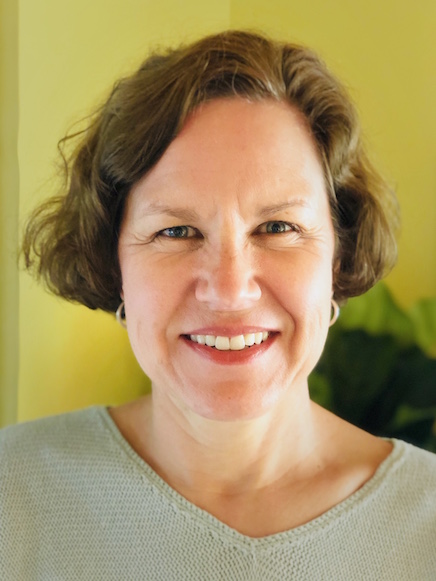
JULIE FOGLIANO
Photo credit: Gerald Young
|
Julie Fogliano is the New York Times–bestselling author of
and then it’s spring and
if you want to see a whale, as well as the poetry collection
When Green Becomes Tomatoes.
Recipient of the 2013 Ezra Jack Keats Award, her books have been translated into more than ten languages. Julie lives in the Hudson Valley with her husband and three children. When she is not folding laundry or wondering what to make for dinner, she is staring out the window waiting for a book idea to fly by.
I, too, have been staring out the window, but what
I've been hoping to snag is this elusive and somewhat enigmatic poet/non-poet author for a
spotlight interview!
There's something so appealing about Julie Fogliano's writing. Lyrical, yet conversational, it evokes a dreamlike mindfulness that is both here-and-now and on the edge of something that's not quite, but very nearly in reach. It transports you, puts you at ease, and fills you with hope—a tall order by anyone's standards.
Her books have been called a "love song to the imagination," "a droll, wistful ode," "nostalgic and fresh," "...playful, breathtaking...," and "in a word, charming." Two years ago, the kidlit poetry community tittered with excitement about
When Green Becomes Tomatoes—the way it tenderly waltzed into our lives, stirring things up like an unexpected breeze. Since then, two more book ideas have been caught and released to the world...
and Julie also has a poem in the recently released
World Make Way: New Poems Inspired by Art by the
Metropolitan Museum of Art, edited by Lee Bennett Hopkins.
With 28 starred reviews (and counting), she is already a force to be reckoned with, but her books and critical acclaim keep coming.
I'm grateful for the opportunity to feature Julie Fogliano's latest poetic picture book, hot off the press:
A house that once was pairs Julie with Caldecott Award–winning illustrator
Lane Smith to create an enchanting and unforgettable story about a boy and a girl who discover an abandoned house.
Entering through "a window that's watching ... a window that says climb inside," they explore the house's contents and imagine answers to questions like
Who lived here? Why did they leave? and
Where did they go?
When you have a spare minute, you should definitely read Elizabeth Bird's thorough and glowing review at
School Library Journal. More briefly, Kirkus describes
a house that once was as "perfectly seamless; words and art are interwoven in a dance that enchants. Inventive and lovely."
That, it is. Julie's free-flowing stream of text wanders in and out of contemplation, levity, rhythm and rhyme, blending beautifully with Lane Smith's illustrations that drift in and out of three artistically-defined worlds—a colorful reality, a ghostly dimension, and a richer, more vibrant world of imagination.
The result is captivating, timeless, stunning, and thought-provoking. And if you're wondering what the thread is that holds it all together... that's right! It's wonder. Wonder and curiosity—qualities that are characteristic of all great artists and poets, whether you choose to describe yourself as one or not.
Be sure to
visit the book's website for more art than what is featured in today's interview and to download a fun activity kit. But for now, enjoy my conversation with Julie Fogliano. We begin as we do with all Spotlight ON interviews, with five of her favorite things.
Favorite children's author: Ruth Krauss
Favorite childhood memory: On Sunday mornings, my grandma would get up extra early to start making the sauce, and she would always wake me with a meatball in bed.
Favorite food: pasta!
Favorite smell: morning coffee
Favorite vacation spot: Cape Breton, Nova Scotia
Each of and then it’s spring, if you want to see a whale, and When Green Becomes Tomatoes found their genesis in a year of writing daily thoughts—a friend’s clever ruse to get you past your 15 year rut of trying to write a children’s book. (Read more at Jama’s Alphabet Soup.) Now, with a few more books under your belt, I imagine you’ve had to start dipping into other creative sources for material. What kind of routine have you established to nurture a healthy working relationship with your muse?
No, I really haven't changed my routine at all. I don’t necessarily write thoughts of the day anymore (although i will go through spurts of doing it now and then, just for fun). But, I still approach writing the same way. Basically, I discovered that if I just sit down and write, without a plan or an idea, something will eventually come of it. It might take days, or weeks, or months, but it will happen. I wasted a lot of time (years!) forcing ideas that just weren’t meant to be and it ended up making me miserable. I’ve come to love just wandering around in my own head, with no real idea of where I’ll end up.
Two years ago, with the release of When Green Becomes Tomatoes, you confessed that you weren’t all that comfortable with the label of “poet.” It was enough to write with economy and beauty about tiny quiet things. (Read more at Watch. Connect. Read.) Yet here comes a house that once was, which is not only delicate and lyrical, but also flirts with rhythm and rhyme. What are we to make of that? Can we call you a poet yet?
I’m doing my best to just write and not worry so much. To this day, I haven’t sat down and said “I’m going to write a poem now!” I think that would be the kiss of death for me. But, as you mentioned, I love to be economical with words and yes, I love finding the beauty in tiny, quiet things. And, lately I’ve come to really enjoy playing with rhythm and rhyme. So, if all of that results in being called a poet, then I’m okay with that (even if it still makes me a little nervous).
I was touched by your two-part dedication for a house that once was:
for the boys
who found a house
and wondered
and for lane
who knew just what to do
with wondering
Can you fill us in on the backstory of the real house that inspired this book? Also, Lane Smith’s illustrations are, indeed, phenomenal. Would you speak to the connection between your words and his art?
The house that inspired this book is in the woods behind my sister’s house. My boys and my nephews love to explore back there and eventually stumbled upon the house. They were totally fascinated.
 |
| From A HOUSE THAT ONCE WAS (Roaring Brook Press, 2018). Text © Julie Fogliano. Illustration © Lane Smith. |
At the front of the house
the house that is waiting
there's a door that is not really open
but barely.
A door that is closed
but not quite.
A door that is stuck between coming and going.
A door that was once painted white.
They loved looking through all the objects in the house imagining the
person who lived there… books, pens, canned food, old pictures… they
couldn’t imagine how or why someone would just leave and never come
back.
 |
| From A HOUSE THAT ONCE WAS (Roaring Brook Press, 2018). Text © Julie Fogliano. Illustration © Lane Smith. |
Who was this someone
who ate beans for dinner
who sat by this fire
who looked in this mirror?
Who was this someone
whose books have been waiting
whose bed is still made
whose pictures are fading?
It just so happened, that their discovery happened shortly after Lane
asked me to write a picture book for him. I was in agony trying to come
up with a Lane Smith worthy idea. I am a longtime fan of Lane’s work. He
has such a huge range and I
really wanted to write something that would let him stretch in every
direction. When the kids walked in and told me about the house, I
immediately knew. Who better than Lane to bounce back and forth between
fantasy and reality, wonder and melancholy, in such a beautiful way.
Please share a favorite spread from a house that once was and tell us why it’s a favorite.
Oh the twirling girl, for sure.
 |
| From A HOUSE THAT ONCE WAS (Roaring Brook Press, 2018). Text © Julie Fogliano. Illustration © Lane Smith. |
Was there a cat who would sleep by the fire
or a girl who would twirl to her records and sing?
I rarely see what I write… I hear it, and I feel it, but I don’t really see it. But, when I saw that spread… I got chills. She was exactly what was in my head.
Let’s imagine for a moment that you need to leave your current home. Years from now, if I were to ask your house what it remembers about the Fogliano family, what might it tell me?
Oh wow, well we are five people and a dog living in a very tiny house. It is a very sweet and cozy situation, but I often feel like the little old lady who lived in a shoe. So, the house would definitely tell you that there were always dishes in the sink, a huge pile of laundry waiting to be folded and that you couldn’t walk two feet without stepping on a lego.
What’s coming up next for you?
I have a bunch of picture books coming out over the next few years and they are all in various stages. I’m not sure of the exact publication dates for any of them, but the two that are furthest along are: If I Was the Sunshine, illustrated by Loren Long and My Best Friend, illustrated by Jillian Tamaki.
 |
| Baby Julie enjoys one of her very first picture books. |
 Finally, what you have chosen as this month’s ditty challenge?
I spend a lot of time staring out the window. In fact, a few of my books are about what I saw out there.
Finally, what you have chosen as this month’s ditty challenge?
I spend a lot of time staring out the window. In fact, a few of my books are about what I saw out there.
 |
The view from Julie Fogliano's window in Cape Breton.
"It was my view when I was writing If You Want to See a Whale and the
oceany parts of When Green Becomes Tomatoes.” –JF |
So, my challenge is to just stare out the window and write what you see. Is there a bird out there? What is it doing? Is anyone walking by? Where do you think they’re going? Is it raining? What does it sound like? Is there a car going by? A train? It doesn’t have to be anything big or exciting that you write about. Just write what you see. Do that everyday for a week. At the end of the week, read through what you wrote and write your favorite bits on a separate piece of paper. I bet there will be a poem in there somewhere… see if you can find it.
Fabulous! Let's call them "Window Poems."
Julie's challenge reminds me of something Elizabeth Bird said at the end of her
SLJ review:
Admit it, grown-ups. If the universe provided for you an opportunity for full-fledged snooping, devoid of fear or consequence, you’d hoist yourself up on that windowsill too.
It looks like the universe has obliged.
To be clear, your DMC challenge this month is to stare out the window and write a poem about what you see. The part about doing it everyday over the course of a week is recommended, but optional.
(I want to make sure we have some daily ditties to share next week, plus I know some of you are already well-practiced in the art of window poeming!)
But before you retire to your window seat—
Won't you please help me thank Julie for revealing herself to us today? Also, for offering a personalized copy of a house that once was to one lucky DMC participant!
(Winner to be selected randomly at the end of the month.)
HOW TO PARTICIPATE:
Post your poem about what you see out your window on our May 2018 padlet. Stop by any time during the month to add your work or to check out what others are contributing.
By posting on the padlet, you are granting me permission to share your poem on Today's Little Ditty.
Some poems will be featured as daily ditties, though authors may not be
given advanced notice. Subscribe to the blog if you'd like to keep
tabs. You can do that in the sidebar to the right where it says "Follow
TLD by Email." As always, all of the poems will be included in a wrap-up
celebration on the last Friday of the month—May 25th for our
current challenge.
TEACHERS, it's great when students get involved! Ditty of the
Month Club challenges are wonderful opportunities to learn about working
poets and authors while having fun with poetry prompts. Thank you for
spreading the word! For children under 13, please read my COPPA
compliance statement in the sidebar to the right.
FIRST-TIMERS (those who have never contributed to a ditty
challenge before), in addition to posting your work on the padlet,
please send your name and email address to TodaysLittleDitty (at) gmail
(dot) com. That way I'll be able to contact you for possible inclusion
in future Best of Today's Little Ditty anthologies.
BLOGGERS, thank you for publishing your poems on your own blogs– I
love that! Please let me know about it, so I can share your post! Also remember to include your poem (or a direct link
to your post) on the padlet in order to be included in the wrap-up
celebration and end-of-month giveaway.
* * * * * * * * * * * * * * * * * * * * *
Thanks again to everyone who participated in Deborah Bruss and Matt Forrest Esenwine's challenge
last month to write a poem about something you would not expect (or want) a dinosaur, or other animal, to do. We had a couple additions since last Friday's wrap-up celebration.
Click here to take another look.

Random.org has determined that the winner of a personalized copy of
Don't Ask a Dinosaur by Deborah Bruss and Matt Forrest Esenwine, illustrated by Louie Chin is . . .
JESSICA BIGI
We had another drawing this week—my National Poetry Month giveaway. Random.org has determined that five sets of
The Best of Today's Little Ditty (volumes 1 and 2) will go to . . .

MARIBETH BATCHO
SANDRA BOHMAN
TARA BROWN
LEIGH ANNE ECK, and
VICKI WILKE
Congratulations to the winners of both giveaways!
One more quick note before I go. If you've read and enjoyed
The Best of Today's Little Ditty, would you take a minute to
leave an honest review on Amazon.com? (The 2016 edition, especially.) Reviews make a huge difference as to whether or not a book shows up in searches. Thanks so much!
Brenda Davis Harsham has this week's Poetry Friday roundup at
Friendly Fairy Tales.