 |
| BUFFY SILVERMAN |
It's true, we just turned the page to February. But in my neck of the woods temps are back in the 70s, trees are beginning to flower, and look what else arrived this week—a new book to warm my heart.
 |
ON A SNOW-MELTING DAY: SEEKING SIGNS OF SPRING
Millbrook Press (Lerner Publishing Group), February 4, 2020
ISBN: 978-1541578135, available for a discounted price at Lerner Books. |
I'm tickled blossom-pink to introduce my friend and critique partner
Buffy Silverman for our first Spotlight ON interview of 2020! Buffy is the author of more than 90 nonfiction books for young readers, featuring topics from angel sharks to alligators, and Mars to monster trucks. Children's poetry fans might be more familiar with her nature-inspired poems that pop up regularly in anthologies, popular children's magazines, and, I'm pleased to say, here
on Today's Little Ditty.
In
her role as a TLD contributor, Buffy has taught readers much about how connecting with nature can make us better poets. She spends time outdoors every day, occasionally with a dragonfly perched on her nose, but more often accompanied by her dog and camera. There’s always something new to discover living near woods and a lake in rural Michigan, and
taking photographs encourages her to slow down and watch closely—a skill that every good poet must cultivate. I'm delighted to include several of Buffy's outstanding photographs in today's post. (The hardest part was deciding which ones to share!)
One of the qualities I find most remarkable about Buffy's writing is her ability to transform those carefully observed small details into poetry, finding the perfect word in every instance, even when it's one she's had to invent herself. Buffy is adept at wordplay alchemy—something she has practiced from the age of 10 years old.
On a Snow-Melting Day: Seeking Signs of Spring is a superb example of what kind of enchantment can come of it.
 |
| Back cover: On a Snow Melting Day (Millbrook Press, 2020) |
Described in
a starred Kirkus review as “Crocus-poking, mud-luscious enjoyment,” Buffy describes
On a Snow-Melting Day as "an extended poem about all the changes that occur as winter retreats and spring begins. It features chickadees sipping from icicles, spotted salamanders marching over melting snow, and insects warming themselves in skunk cabbage." (Read more from Buffy's interview with Raven Howell
here.)
Vibrant photographs paired with playful rhyming verse will captivate young children, making this book an ideal read-aloud for home, preschool, or library story time. For grades 1-3, teachers will appreciate this book as a mentor text because of the expressive sensory language. They can also make use of the back matter (an informational author's note, glossary, and further reading) to extend and enhance interactive learning. The book is "perfect," according to the School Library Journal, "for answering nature-related questions or crafting lesson plans."
Why not try this simple idea for the classroom:
"Reading poetry to your students can be a gift," explains Buffy in an interview at
Two Writing Teachers. "Let them enjoy listening to a poem each day, without asking for discussion or analysis. Then read the poem again and ask students to remember one or two favorite words. Write those words in a class word bank, and encourage your students to borrow them for their own writing."
And what should they write? How about "drip-droppy, slip-sloppy" poems in response to Buffy's DMC challenge this month! You'll find detailed instructions later on in this interview.
Let's begin, as always, with five favorites.
 |
| Buffy Silverman |
FAVORITE COLOR:
Pale green, the color of fresh leaves in spring.
FAVORITE SMELL:
The scent of soil after a rainstorm. There’s a word for that smell—petrichor—which comes from the Greek words petra ( meaning stone) and ichor (a fluid flowing in the veins of the gods.)
FAVORITE SOUND:
The flute-like song of a wood thrush on an evening in May.
FAVORITE GRADE IN SCHOOL:
In fourth grade, Mrs. Rasanen had a reel-to-reel tape player and played a song for us that went, “Hey ho, what do you know, friction makes heat. Hey ho, what do you know, we’re making heat!” Combining music with science was pretty radical at the time (and that might be why I can still sing the tune while rubbing my hands together!) Fourth grade was also the year we took a class trip to Sturbridge Village.
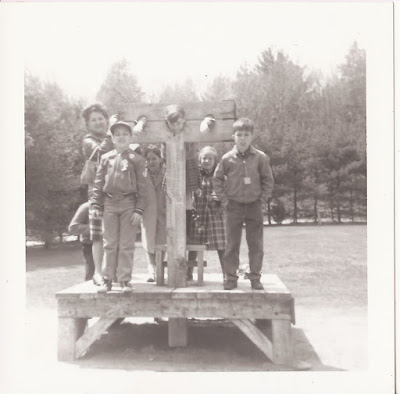 |
| Buffy, the 4th grade outlaw, with some of her classmates at Sturbridge Village |
FAVORITE TEACHER IN SCHOOL:
Mr. Kirkpatrick, eleventh grade English. I was often unengaged in classes in junior high and high school. But Mr. Kirpatrick told me that I was a good writer—and he took the time to show me how to make my writing stronger. His words and attention set me on a different path. Understanding how to revise what I wrote helped turn me into a successful student in college and a writer today.
As a child you were a tree climber, an insect finder, and a word collector, yet you didn’t begin thinking of yourself as a writer until graduate school. When did you realize you were a poet?
I’m not sure I think of myself as a poet. Let’s just say I’m someone who enjoys writing poetry. (The first definition in the dictionary of a poet is someone who writes poetry, so perhaps someday soon I will embrace the term.) I’ve always loved playing with language, and I think that led me to dabbling in poetry.
Your bibliography, especially for the nonfiction educational market, is quite impressive! What do you enjoy most about writing for that market?
For me there have been two great benefits to writing for the educational market. The first is having tight writing deadlines. I am a procrastinator, and deadlines force me to be organized and to keep writing. The second is learning about a wide range of subjects, including many that I had little knowledge of before diving head first into the research. I now understand why airplanes have flaps, big rigs have tails, and how to bring a hot air balloon down to earth!
How does poetry fit into the big picture of your writing career?
While I’ve enjoyed having writing assignments and learning many, many interesting tidbits, I’m trying to shift the focus of my writing to more narrative and poetic approaches to nonfiction (and maybe even some fiction, too!) I am drawn to writing about the natural world, which I think is a subject that inspires poetry.
 |
| Buffy Silverman |
 |
| Buffy Silverman |
 |
| Buffy Silverman |
What I love most about On a Snow-Melting Day is your fun, evocative language. Your description of the change of season is factual, yet never trite or dull. Can you tell us more about your process of writing the book?
On a Snow-Melting Day started as an idea for StoryStorm 2018, in response to a blog post that encouraged writers to pay attention to what’s around them. Here’s what I wrote in my notebook:
It was a drip droppy
slip sloppy
snow melting day
Then I made a few notes about mist rising in the air, boots sinking in the slush, puddles growing on the lake. My notes continued: Is there a story here? Or just a poem?
Initially I thought the image in my head was more of a poem than a story idea, but about a month later I had a writing day with my critique group and decided to explore the idea more fully. I thought about what different animals might be doing on a series of snow-melting days and tried to paint a picture of the landscape getting closer and closer to spring. I pictured the woods, lake, and marshy areas that are outside my door.
 |
Buffy Silverman
(featured in On a Snow-Melting Day)
|
 |
Buffy Silverman
(featured in On a Snow-Melting Day)
|
I managed to finish a draft in one day (which is not usual for me. Peer pressure is wonderful! Go write with your friends!) Of course, I revised that draft many times.
The photographs complement your spare text so perfectly. Considering that this book is not traditionally illustrated, were you involved in the process of selecting the photos or was your expressive writing all the in-house designers needed?
Allison Juda, the Millbrook editor assigned to my manuscript, chose the photographs and masterfully designed the book with little input from me. I offered Allison several of my own photographs that I thought might work with my manuscript and was thrilled when she decided to include three of them. There was one part of my text that Allison didn’t understand and she wondered if I should change: Icicles drip. Chickadees sip.
 |
| From On a Snow-Melting Day: Seeking Signs of Spring (Milbrook Press, 2020) |
But she was fine about keeping that couplet once I sent her links to photos of chickadees sipping icicles. (Who knew they did this? Not me until I started searching for an animal that drinks from icicles.) I believe the chickadee-sipping photo used in the book was one that I had sent to Allison. I also suggested which flowers to include in the final spread (hepatica) to make sure we had one of the earliest blooming wildflowers.
Please share a favorite spread from On a Snow-Melting Day and tell us why it's a favorite.
How can I decide on only one?! If I must choose, I’ll go with this one: On a plink-plonking, marsh-mucking, duck-dabbling day.
 |
| From On a Snow-Melting Day: Seeking Signs of Spring (Milbrook Press, 2020) |
Those phrases are fun to say, I love pussy willows, and I have a nice memory of walking with my daughter at the Kellogg Bird Sanctuary when I took the photo of the handsome pair of mallards.
Let’s imagine for the moment that On a Snow-Melting Day is part of a four-book series (which it should be!) describing each of the seasonal transitions in a similar fashion. What is one thing you might have observed for each of the other books in the series?
There’s so much wonder in the world as the seasons change. Here are a few favorite sights: frogs staking out their territories and serenading their sweethearts as spring turns to summer; praying mantises laying their foamy egg cases on tall grasses when summer turns to fall; huge flocks of sandhill cranes gathering to dance and raise a ruckus as fall turns to winter. Whether or not those critters would fit neatly into a rhyme scheme is another question!
 |
| Buffy Silverman in her childhood happy place |
If you had all the world's children in one room, what would you tell them?
Go outside (every day if you can!) Look, listen, feel, and smell nature. Let yourself fall in love with our world.
 Finally, what you have chosen as this month's ditty challenge?
I had great fun combining and inventing words when writing On a Snow-Melting Day. I think TLD readers would enjoy this too. Here’s a recipe to follow, or strike out on your own.
INGREDIENTS:
Five or more nouns (choose plants/animals/weather-related nouns, or anything else you observe outside.)
Five or more verbs that are actions your nouns might take and/or sounds that your nouns might make.
INSTRUCTIONS:
1. Take a walk or look out a window to gather the ingredients listed above.
2. Combine each noun-verb pair to create an adjective. (These are some that I used in Snow-Melting Day: hawk-squawking, marsh-mucking, paw-sinking, duck-dabbling.)
3. Play with your combinations to create different adjectives (paw-dabbling? duck-squawking? marsh-sinking?)
4. Write a poem that celebrates the place you observed, using at least two of your noun-verb combinations or other invented words.
Grab your notebook and trail mix, my friends—
Finally, what you have chosen as this month's ditty challenge?
I had great fun combining and inventing words when writing On a Snow-Melting Day. I think TLD readers would enjoy this too. Here’s a recipe to follow, or strike out on your own.
INGREDIENTS:
Five or more nouns (choose plants/animals/weather-related nouns, or anything else you observe outside.)
Five or more verbs that are actions your nouns might take and/or sounds that your nouns might make.
INSTRUCTIONS:
1. Take a walk or look out a window to gather the ingredients listed above.
2. Combine each noun-verb pair to create an adjective. (These are some that I used in Snow-Melting Day: hawk-squawking, marsh-mucking, paw-sinking, duck-dabbling.)
3. Play with your combinations to create different adjectives (paw-dabbling? duck-squawking? marsh-sinking?)
4. Write a poem that celebrates the place you observed, using at least two of your noun-verb combinations or other invented words.
Grab your notebook and trail mix, my friends—
we're going word-wandering!
 |
| Buffy's woods-walking companion Dakota is expert at sniffing out new words! |
But before setting off, please help me thank Buffy—and Dakota—for being here today (though I've been told Dakota is only in it for the kibble). Buffy, on the other hand, is looking forward to reading your poems and is offering a personalized copy of On a Snow-Melting Day: Seeking Signs of Spring to one lucky DMC participant!
(Winner to be selected randomly at the end of the month.)
HOW TO PARTICIPATE:
Post your poem with invented words on our
February 2020 padlet. Stop by any time during the month to add your work or to check out what others are contributing.
By posting on the padlet, you are granting me permission to share your poem on Today's Little Ditty.
Some poems will be featured as daily ditties. I don't typically give authors advance notice, so subscribe to the blog if you'd like to keep
tabs. You can do that in the sidebar to the right where it says "Follow
TLD by Email." All of the poems will be included in a wrap-up
celebration on the last Friday of the month—February 28th for our current challenge.
TEACHERS, it's great when students get involved! Ditty of the
Month Club challenges are wonderful opportunities to learn about working
poets and authors while having fun with poetry prompts. Thank you for
spreading the word! For children under 13, please read my COPPA
compliance statement in the sidebar to the right.
FIRST-TIMERS (those who have never contributed to a ditty
challenge before), in addition to posting your work on the padlet,
please send your name and email address to TodaysLittleDitty (at) gmail
(dot) com. That way I'll be able to contact you if necessary.
BLOGGERS, thank you for publishing your poems on your own blogs– I
love that! Please let me know about it, so I can share your post! Also
remember to include your poem (or a direct link to your post) on the
padlet in order to be included in the wrap-up celebration and
end-of-month giveaway.
* * * * * * * * * * * * * * * * * * * *
Thanks to Laura Purdie Salas for hosting
this week's Poetry Friday roundup. She is writing poems in a variety of unusual places this year and today shares a poem written at the orchestra.


