First, tap-tap-tap-tap-tap on morning’s bedroom floor, impatience played between long stretches, yawns.
Then scratch-scratch-scratch-scratch-scratch, the tugs at bedside covers pull my sheets, beg for me to peek —at least one eye— to see a wide-eyed plea.
Next rat-tat-tat-tat-tat claws celebrate surrender. Though reluctant, I arise and stumble to the backyard door in early-dark, accompanied by staccato joy.
A caesura, fermata—a pause.
Then, my slow wake, my long-drawn-out capitulated yawn breaks short at sudden rhythms, scrape-scrape-scrape-scrape-scrape, wood-scarring pleads upon the door.
I let them in, all four percussion-gifted paws. My day begins with music to my ears.
Send your poem to TodaysLittleDitty (at) gmail (dot) com, or use the
contact form in the sidebar to the right. All contributions will be
included in a wrap-up celebration on Friday, March 25th, and one lucky
participant will win a personalized copy of her delightful nonfiction picture book:
Carrie Clickard has encountered some of the most villainous versifiers in the line of duty.
Today, in the spirit of political shenanigans and social unrest, she enlists the help of fuzzy ducks to make sense of it all. Well, not really ducks exactly... Sneetches.
Whether or not you have stars upon thars, enjoy this latest installment from TLD's Rhyme Crime Investigator!
(Click on the wanted posters for Carrie's previous posts.)
A look at a legend: Scanning the Seuss man
There are over sixty Dr. Seuss books in print today and over 100 million copies have been sold. His books are read around the world in more than twenty languages. Clearly he has a lot to teach any of us about how to craft successful rhyme. There are only a rare few out there in writer-land that might claim to do it better.
That doesn’t mean, however, that every Seussian work is absolutely flawless. Let’s take a Rhyme Crime look at THE SNEETCHES by Dr. Seuss, our mentor text for today, and see how it holds up to scrutiny. (You'll find the video version HERE.)
First, a disclaimer: Before I set out, I must confess to being a lifelong fan-girl of the Seuss man. This may mean that during this critique I cut him more slack than I should. Feel free to call me on it, or chime in with your own observations, if you think I’ve missed something useful.
Let’s start with some basics.
WORD COUNT: 826 words, THE SNEETCHES might be considered a bit long in today’s market, but not intolerably so. Many editors now say the sweet spot for picture books is 500 words and under, but that’s not a hard and fast cutoff. Three of my four rhyming picture books have over 700 words.
RHYME SCHEME: Rhyming couplets. A-A, B-B, C-C etc. (with one or two exceptions).
METER: Anapestic Tetrameter, aka Reverse Dactyl. Each line of the verse can be divided into four feet, each foot has three beats, with the stress/accent on the third beat:
da da DAH, da da DAH, da da DAH, da da DAH.
However be warned: the good doctor takes a few liberties with his meter along the way, and we’re going to talk about that first.
Ready to dive in? Here we go:
Now, the STAR-belly SNEETCHes had BELLies with STARS. The PLAIN-belly SNEETCHes had NONE upon THARS.
Right here in the opening couplet Seuss sets us up for a slightly nonstandard rhythm. The first line has 12 beats. The second line has 11. The first line is straight anaPEST, emphasis on every third syllable. But the second line skips the first beat. Its first foot is iambic, then it falls back into anapestic for the next three feet.
Some people might read it aloud without an accent on SNEETCH in the second line at all:
The PLAIN-belly sneetches had NONE upon THARS.
da DAH da-da da-da, da DAH, da da DAH
So what is Seuss’ intent? It’s a little too early to tell. Maybe this is a unique rhythm pattern that we can follow through the poem. Let’s try the next couplet and see.
Those STARS weren’t so BIG. They were REAL-ly so SMALL You might THINK such a THING wouldn’t MATter at ALL.
Hmmm. This time we have a shorter line first, 11 beats, starting with that short iambic foot. And then we have a 12 beat line, straight anapest. That makes the first two couplets mirror images of each other.
Maybe that’s a clue. Seuss could be building four line stanzas with this pattern:
Interesting. Let’s try another four lines. I won’t mark them out. Let’s see if you read them the same way I do.
But, because they had stars, all the Star-Belly Sneetches Would brag, “We’re the best kind of Sneetch on the beaches." With their snoots in the air, they would sniff and they’d snort “We’ll have nothing to do with the Plain-Belly sort!”
It’s not quite a match, is it? Line two does start out with a short two beat foot, but line three is straight anapest, and so is line four. And did you catch the extra beat in both lines of the first couplet?
Clearly, Seuss is being a bit, ahem, flexible in his meter and structure. From our reading so far, it seems we need to let each couplet stand on its own. Okay. I’m game. Of the next six couplets there are:
two couplets with the “short” second line
one with a short first line
one that has both lines in perfect anapest
and two couplets where BOTH lines start with the “short” foot.
PHEW! If that’s a pattern, it’s one for a crazy quilt. So what in the world does all of this mind-boggling, syllable counting tell us? Have we discovered a fatally flawed Dr. Seuss book?
No, no. I’m not about to sully the great Seuss’ honor. What we have here, in my opinion, is an excellent example of letting the verse serve the story, and NOT the other way around. Clearly Seuss is not following the precise form or sticking to rigid line length and meter. And yes, he’s definitely bending a few rules. But does it harm the story? Does it make the book bad to read aloud?
Not one bit.
Take a moment and read the rest of the way through the book as you would with a child, letting your narrative voice take over instead of your inner critic. Notice how the change in rhythm often emphasizes a point in the plot. A tiny difference in line length breaks up the text just where the rhythm might become too repetitive. The liberties Seuss takes actually strengthen his storytelling.
This is a hard lesson to learn: knowing when it’s okay to bend the rules as rhymers. Bend them too much, or too early in your career, and you may find your work labeled as “inconsistent” or “unpolished” by editors. Avoid bending them at all and you risk writing sing-song, snooze worthy verse.
That’s not to say there aren’t a few areas where the Sneetches’ rhyme could have been the eensiest bit stronger. (I won’t say better. Nope. Not me.) Let’s look at two quick examples.
One:
Seuss’ choice of using dialect for “thars” to rhyme with stars, yet not using any other southern or western pronunciations, feels a bit like cheating. It’s cute and it works within the story, but I’m not sure it would fly with many of today’s editors. If I was giving feedback to a crit buddy, I’d probably label this a prime example of using weasel words to get out of a tough rhyme situation.
Two:
In the middle of the text Seuss uses one of his marvelous made up words:
So they clambered inside. Then the big machine roared And it klonked. And it bonked. And it jerked. And it berked And it bopped them about. But the thing really worked!
“Berked.” It’s funny sounding and fun to read aloud, and more importantly it rhymes with “worked” and “jerked.” But where most of Seuss’ other word creations are hilarious onomatopoeia, wildly imagined creatures or fantastical inventions, this one seems made up solely to get him out of a tough rhyme spot. The same can be said for his couplet that reads:
"...I’ll make you, again, the best Sneetches on beaches And all it will cost you is ten dollars eaches."
Eaches? Really?
Because he’s Seuss, he can get away with it. I strongly suggest you don’t try it until you’ve published at least half as many books as he has. (wink)
Thanks once again for coming along on another Rhyme Crime investigation. I hope you found something useful to squirrel away in your writer’s tool cabinet. And if you’re out there listening, dearest Doctor, forgive me my presumption. No one has inspired me more.
Go on now, write something amazing.
Thanks for another amazing and inspiring post, Carrie!
Carrie Clickard is an internationally published author
and poet. Her first picture book, VICTRICIA MALICIA, debuted in 2012 from
Flashlight Press. Forthcoming books include MAGIC FOR SALE (Holiday House, 2017), DUMPLING DREAMS (Simon and Schuster 2017) and THOMAS JEFFERSON & THE MAMMOTH HUNT (Simon and Schuster, 2017). Her poetry and short stories have appeared in numerous
anthologies and periodicals including Spider, Andromeda Spaceways Inflight Magazine, Havok, Myriad Lands, Clubhouse, Spellbound, Penumbra, Haiku of the Dead, Underneath the Juniper Tree, Inchoate Echoes, and The Brisling Tide.
In case you missed last week's spotlight interview with Amy Ludwig VanDerwater, she's challenged us to write poems about small things– animals or objects you see everyday and don't give much thought. Click HERE for more details. Featured this week were poems by Jessica Bigi and Joy Acey, as well as a related quotation by Yoko Ono.
Thanks to Irene Latham for hosting this week's Poetry Friday roundup at Live Your Poem.
Amy Ludwig VanDerwater has challenged us to write poems about small
things— animals or objects you see everyday and don't give much thought.
Click HERE for more details.
Send
your poem to TodaysLittleDitty (at) gmail (dot) com, or use the contact
form in the sidebar to the right. All contributions will be included in
a wrap-up celebration on Friday, March 25th, and one lucky participant
will win a personalized copy of her nonfiction picture book:
Amy Ludwig VanDerwater has challenged us to write poems about small things— animals or objects you see everyday and don't give much thought. Click HERE for more details.
Send your poem to TodaysLittleDitty (at) gmail (dot) com, or use the contact form in the sidebar to the right. All contributions will be included in a wrap-up celebration on Friday, March 25th, and one lucky participant will win a personalized copy of her nonfiction picture book:
Amy Ludwig VanDerwater has challenged us to write a poem about something small, an animal or object you see every day and do not usually give much thought. Send your poem to TodaysLittleDitty (at) gmail (dot) com or use the contact form in the sidebar to the right. For more information, click HERE.
I have always liked little things, and great poems are little things that can make us more of who we are. One great line of poetry can help a person make a big decision or do a kind deed. Poetry truly matters.
I love this quotation because it truly encapsulates what Amy Ludwig VanDerwater stands for... as a poet, as a teacher, as a person.
The interview took place in March of 2013, just days before her long-awaited debut collection of children's poetry FOREST HAS A SONG (Clarion, 2013) hit the shelves. Since then, I've joined the ranks of those eagerly anticipating her next several books for children — EVERY DAY BIRDS (Orchard/Scholastic, 2016), READ! READ! READ! (WordSong, 2017), DREAMING OF YOU (Boyds Mills Press, 2018), and WITH MY HANDS (Clarion, date TBA). Fortunately, the wait for something new has been made easier by the fact that Amy is frequently anthologized. I shared her poem "Book Pillows" from Lee Bennett Hopkins' anthology JUMPING OFF LIBRARY SHELVES (WordSong, 2015) last September. She is also co-author of the second grade poetry book in the UNITS OF STUDY (Heinemann, 2013) and author of a forthcoming professional book about poetry.
Some of you might recognize Amy's name in association with her blog, The Poem Farm. Poetry enthusiasts, students, librarians, and teachers flock to the Poem Farm because of the care, thought, and heart she puts into each of the poems and lessons she posts. Amy herself has taught writing to teachers and students for eighteen years, making The Poem Farm a comfortable fit for many classrooms. In that same generous spirit, she also welcomes notebook keepers of all types to share their creative process at her other blog, Sharing Our Notebooks. For more information about Amy, or to schedule a school visit or teacher workshop, visit her website.
Please join me in welcoming Amy Ludwig VanDerwater to the Today's Little Ditty spotlight.
Living out in the country, it's not surprising that Amy is inspired by nature. The driving force behind both FOREST HAS A SONG and EVERY DAY BIRDS—her latest book with illustrator Dylan Metrano—has been to share that sense of wonder with others. (Find out more about the beginnings of EVERY DAY BIRDS here.)
EVERY DAY BIRDS
Orchard Books, an imprint of Scholastic
(February 23, 2016) ISBN: 978-0545699808
On shelves now. Order your copy HERE.
Last year's babies, almost ready to fly.
Waiting for eggs
(Looks like our holiday wreath
will be up for a while!)
My every day experience with birds is focused primarily on the little cuties that nest in whatever wreath happens to be hanging on our front door. Sure, it's an inconvenience, but you can't beat the free concerts or the experience of watching nature take its course. We also share the
neighborhood with cardinals, crows, turkey vultures, occasional
hawks and woodpeckers, and lots of other birds I don't know the names of.
Where my knowledge is lacking, Amy's is not. EVERY DAY BIRDS hopes to share the joy of birdwatching with even the youngest, 2-5 year old ornithologists. (Although, truth be told, this not-so-young beginner learned a thing or two, as well!) Amy has chosen her subjects carefully to ensure that these are birds children are likely to recognize in their daily lives, making this Junior Library Guild Selection an ideal choice for home, classrooms, or library storytime.
Opening the book, we are welcomed with
Every day we watch for birds weaving through our sky. We listen to their calls and songs. We like to see them fly.
made captivating by the talent of papercutting artist Dylan Metrano:
Text from Every Day Birds written by Amy Ludwig Vanderwater. Illustrations copyright 2016 by Dylan Metrano.
Used with permission from Scholastic Press. (Click on image to enlarge.)
Continuing on in that rhyming format, twenty common
North American birds are introduced, one per page, along with a signature characteristic for each. The accompanying cut-paper illustrations are striking, bringing the birds to bold, beautiful life in a truly compelling fashion. (Be sure to check out Dylan Metrano's process of creating the art for EVERY DAY BIRDS.) The whole poem is repeated at the back, followed by a closing section with additional facts about each bird family to continue the learning.
Described as "beginning birding at its best..." by Kirkus Reviews and "a great way to expose children to the wonders of nature, many of which are in their own backyards" by School Library Journal, EVERY DAY BIRDS should be in the hands of every child who is curious about the world around them. (And what child isn't?)
At this point, I imagine you're pretty curious to know more about Amy, so let's get started with the interview.
Had I known when I sent her interview questions that "choosing favorites" was among the few things she doesn't like, I might not have started this interview with the usual five favorites. Fortunately, Amy was kind enough to oblige nonetheless.
I personify most everything, so I don’t have many favorites because I fear hurting the feelings of unchosen foods, colors, and animals. But here are a few things I love:
FAVORITE TEACHER IN SCHOOL: One who still lives in my heart is Mr. Fron from sixth grade. He lived in his own way and through his example I came to understand that different can be wonderful. I wrote an essay about him HERE. FAVORITE FOOD: Popcorn, cooked in oil on my stovetop with real butter and salt. Or raspberries. Or red licorice.
FAVORITE SOUND: Maybe rain. Maybe the silence of snow.
The VanDerwater family home away from home. Photo: Mark VanDerwater
FAVORITE VACATION SPOT: My husband’s family’s little cabin in the Adirondacks, tucked in the woods on a creek with a pink granite bed. Grandpa and Grandma VanDerwater built this humble building with materials they found, and I love to remember them as I watch our children and their cousins ride inner tubes down the creek.
FAVORITE QUOTE: “Then it is only kindness that makes any sense anymore...”
– from Naomi Shihab Nye’s poem, “Kindness.”
What drives you to create books for children and what aspects of your career do you enjoy the most?
I think that I write for children because I write for myself, and I
still feel so much like a child. Puff the Magic Dragon is really alive
for me. I am seven. I also love the surprises that come through writing, trusting and finding that an idea will always come out to play if only I am patient enough to coax it onto the page. Too, it is an honor when a child tells me that s/he cared about something I wrote. Connections. I love connections.
You live in an old farmhouse on 24 acres of land. While this sounds idyllic on one hand, on the other, I know it must involve a tremendous amount of upkeep. You also lead the busy life of a mom caring for three active teenagers. How do you fit writing into your daily routine at Heart Rock Farm?
"Our porch in summer. You can see Pickles the cat sleeping
on the table. We have cats everywhere!" – Amy LV (click photo to enlarge)
I am a pretty casual housekeeper, a random cook, and a spotty gardener. We all eat dinner together nightly, but as I put my family and friends first and my writing second, dinner may involve a strange assortment of foods. While daily life is not always lovely or conventional, I am at peace with making choices around what I most value: people and words.
Keeping notebooks is a passion of yours. You’ve said that you often use them to “write your way into a poem.” Can you elaborate on that process?
"Keeping notebooks has taught me
that our whole world is one big nest
of ideas." –Amy LV on No Water River
Quite often, I have no idea what to write. So I just write about whatever comes to mind, skipping around the page and my life, sniffing for a scent that might take me off on a chase. If I write long enough, something shows up. It is all about trust and surprise.
What about EVERY DAY BIRDS makes you happiest?
My husband Mark is very knowledgeable about birds, so much more so than I am. Since we have been married, he has fed the birds in our yard, and he has taught our children and me about various birds and their habits. Learning about birds has added a magical layer to my own life, and I most hope that EVERY DAY BIRDS will pass this enchantment on to other children and parents too.
Feathered friends at Heart Rock Farm.
"Learning about birds has added a magical layer to my own life..." – Amy Ludwig VanDerwater
Dylan Metrano’s cut paper illustrations are magnificent. They bring birds to exquisite life on the pages; I’m thrilled to have had my words paired with Dylan’s talent.
Text from Every Day Birds written by Amy Ludwig Vanderwater.
Illustrations copyright 2016 by Dylan Metrano.
Used with permission from Scholastic Press. (Click to enlarge.)
Which of the birds described in EVERY DAY BIRDS is your favorite?
I just love chickadees. I have a chickadee poem in FOREST HAS A SONG, and I laugh to say that I want a chickadee in every book I ever write. They are small and hearty, brave and friendly, and I want to hug them.
Text from Every Day Birds written by Amy Ludwig Vanderwater.
Illustrations copyright 2016 by Dylan Metrano.
Used with permission from Scholastic Press. (Click to enlarge.)
The Worldwide Association of Rhymesters and Bird-Labeling Enthusiasts (WARBLE) is considering a new classification of bird called the VanDerwater. Please describe her signature characteristics.
You are funny! This bird has a happy song and a messy nest.
Can you give us a hint about what's coming up next for you?
In Fall of 2017, Wordsong will publish my poetry collection READ! READ! READ!, to be illustrated by Ryan O’Rourke. Next up is a picture book with Boyds Mills Press titled DREAMING OF YOU, a poetry collection with Clarion titled WITH MY HANDS: POEMS ABOUT MAKING THINGS, and another picture book still in the works. I also have a book for teachers on the way, and contract details are being finalized on that now. I feel very lucky.
"Ada wrote a poem in honor of birds." – Amy Ludwig VanDerwater
If you had all the world’s children in one room, what would you tell them?
There is a lot of goodness in this world. Let’s be part of it.
Finally, what you have chosen as this month’s ditty challenge?
Small as a Chickadee: Write a poem about something small, an animal or object you see every day and do not usually give much thought.
Read Amy's poem about a chickadee at The Poem Farm.Photo: Amy LV
A chickaDEELIGHTFUL ditty challenge! I cannot wait to see what small treasures land in my inbox.
Many thanks to Amy for today's interview, and also for generously
providing a personalized copy of EVERY DAY BIRDS to one lucky DMC
participant, chosen randomly at the end of the month.
HOW TO PARTICIPATE:
Throughout the month send your poems about small things to TodaysLittleDitty (at) gmail (dot) com or use the contact form in the sidebar to the right.
For children under 13 who would like to participate, please read my COPPA compliance statement located below the contact form.
Some poems may be published on the blog as daily ditties, but all of them will appear in a wrap-up celebration on March 25, 2016.
BLOGGER FRIENDS:
Thank you for publishing your poems on your own blogs– I love that! Please also remember to send me a copy of your poem or a direct link to your post. That way I know I have your permission to post your poem on Today's Little Ditty.
Thanks again to those who participated in last month's challenge brought to us by David L. Harrison. It warmed my heart to be surrounded by so much dittylove!
Random.org has determined that the winner of a copy of NOW YOU SEE THEM, NOW YOU DON'T: Poems About Creatures That Hide by David L. Harrison, with illustrations by Giles Laroche is:
MINDY GARS DOLANDIS—Congratulations, Mindy!
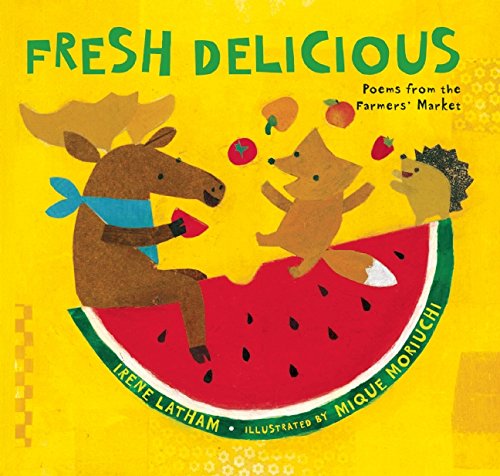
If you missed my review of FRESH DELICIOUS: Poems from the Farmers' Market earlier this week, you can find it HERE.
Get your inspiration recharged at the Poetry Friday roundup. It's hosted this week by Linda Baie at TeacherDance.
I also happen to love Irene's gracious personality and the authenticity with which she lives her life as a creative artist. If I could hire her as my personal guru, I would.
Irene Latham was one of Today's Little Ditty's first Spotlight ON interviews, celebrating the release of DEAR WANDERING WILDEBEEST: And Other Poems from the Water Hole (Millbrook Press, 2014). This year she has two new collections of children's poetry— WHEN THE SUN SHINES ON ANTARCTICA: And Other Poems about the Frozen Continent (Millbrook Press, February 2016) and FRESH DELICIOUS: Poems from the Farmers' Market (WordSong, March 2016).
I've been excited about FRESH DELICIOUS since last summer, when a few of us were given a sneak peek at an SCBWI workshop with Rebecca M. Davis, senior editor for Boyds Mills Press and WordSong. I'm pleased to finally be able to share that excitement with you!
this collection is as fresh and delicious as they come!
Twenty-one whimsical poems about farmers' market produce are paired with Mique Moriuchi's playful collage illustrations to delight readers from age 4 to 104. Although I won't be doing an in-depth review of FRESH DELICIOUS (Jama Rattigan already did a brilliant write-up on Jama's Alphabet Soup), I'd like to share my personal impressions and a couple of poems.
What appeals to me most about this collection is that it's chock full of wonder. Several of the poems remind me of the work of another favorite poet, Valerie Worth. In writing her "small poems," Valerie Worth keenly examined ordinary objects to find each one's "mysterious poetry," as she called it,
"...a poetry still wordless, formless, inaudible, but asking to be translated into words and images and sounds—to be expressed as a poem. Perhaps it could be said that written poetry is simply a way of revealing and celebrating the essentially poetic nature of the world itself." — from Lee Bennett Hopkins' NCTE Profile of Valerie Worth
Whether it's a fleet of green submarine cucumbers, basil butterfly wings, summer squash punctuation, or treasure chests of farm fresh eggs, Irene pays respect to that inventive process in FRESH DELICIOUS. With a flavor all her own, ordinary produce becomes extraordinary as we discover each fruit and vegetable's unique and unexpected character. Irene is masterful at capturing both the imagination and enthusiasm of her youngest readers as they discover the joys of healthy eating, right down to the handful of recipes at the back of the book.
I'm telling you, kids are going to gobble this book up... and their fruits and vegetables too!
My favorite spread from FRESH DELICIOUS has two poems about corn-on-the-cob. When I approached Irene about sharing her corn poems, she sent me a scrapbook page that included this photo of her Granddaddy Dykes standing in front of his corn garden. Isn't it marvelous?
Irene says, "this book is very much tied to my memories of summers spent at my grandparents' Port Saint Joe, Florida home... back then I didn't need a farmers' market, because we WERE the farmers!"
Now, on to the poems....
The first one I'm sharing is a perfect example of what I was talking about earlier— the revelation of corn's unique and unexpected character.
ABOUT CORN Mama says we call them ears for the way they grow on the sides of the stalk— pert and tufted, tilted away from one another, listening to the sun.
Listen... did you hear that?
The sun is saying don't miss out on the opportunity to share this charming collection of poetry with all the special mice, bunnies, and other little ones in your life!